
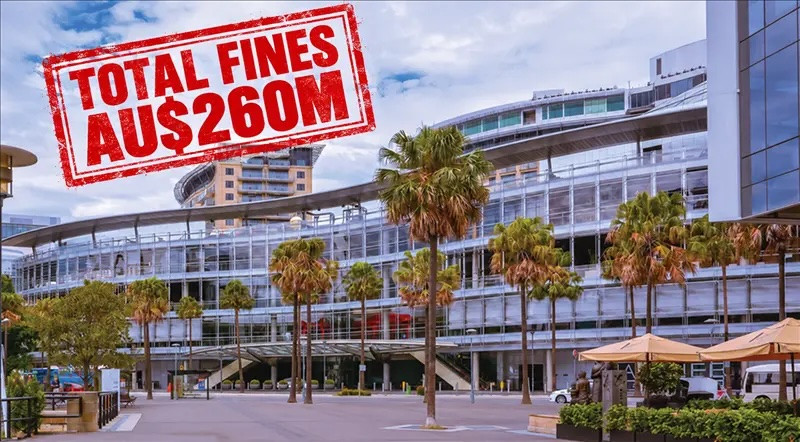

Note: An earlier version of this of this story mistakenly put the total payable at AU$455 million. The full penalty amount payable by Star is AU$260 million.
Australia’s Federal Court has ordered Star Entertainment Group to pay a total AU$260 million (US$183 million) in penalties for contraventions of the country’s anti-money laundering and counter-terrorism financing (AML/CTF) laws.
The penalties, representing the conclusion of a civil case brought by AUSTRAC in 2022, comprise a AU$195 million (US$137 million) fine for The Star Sydney and AU$65 million (US$46 million) fine for The Star Gold Coast, reflecting the greater contraventions committed at the Sydney property. The penalty is to be paid in four equal instalments over 19 months.
In a ruling handed down Wednesday morning in the civil case first brought by AML regulator AUSTRAC in 2022, Justice Cameron Moore said the AU$100 million (US$70 million) fine proposed by Star was too low and AU$400 million (US$280 million) proposed by AUSTRAC too high.
While noting the gravity of Star’s contraventions and evidence that it put “profit ahead of compliance,” Justice Moore also refuted attempts by AUSTRAC to compare Star’s actions with those of fellow Australian casino operator Crown Resorts, which in 2023 reached a AU$450 million settlement agreement with the regulator.
Specifically, he said it was important to issue a financial punishment high enough to deter similar activity in the future while keeping in mind events since the civil case was first filed, including Star’s precarious financial position, fines already paid and the significant compliance measures it has taken such as the introduction of mandatory carded play at The Star Sydney.
Given the “material changes” it has made to the business, Justice Moore said, “The prospect of Star engaging in a repeat of the conduct the subject of these proceedings is significantly reduced.
“Further,” he added, “Star has already paid a significant price for the contravening conduct. These matters reduce the penalty that otherwise would have been required in these proceedings to serve the object of specific deterrence. They also have an impact on the penalty required for general deterrence.
“These reasons will make plain that, but for the State regulatory response to the conduct, including the [previous] levying of significant penalties, the license suspension and the resulting onerous requirements and controls, the penalty for Star would have been higher.
“I also take it into account in ordering that the penalty be paid by way of instalments. Star’s profitability is such that it is likely to need to raise money to pay any penalty. Its ability to pay the penalty should not be jeopardised by requiring it to be paid all at once, as AUSTRAC proposes.”
Justice Moore added that while he rejected AUSTRAC’s call for the full amount to be paid at once, he did agree that the penalty imposed on The Star Sydney should be three times higher than that imposed on The Star Gold Coast due to the gravity of their respective contraventions.
The civil proceedings against Star followed the launch of an initial investigation into the company in June 2021, which was expanded to incorporate the company’s Queensland operations in January 2022.
AUSTRAC alleged, among others, that Star failed to appropriately assess the money laundering and terrorism financing (ML/TF) risks they faced; did not include in their AML/CTF programs appropriate risk-based systems and controls to mitigate and manage the risks to which the Star Entities were reasonably exposed; failed to establish an appropriate framework for Board and senior management oversight of the AML/CTF programs; did not have a transaction monitoring program to monitor transactions and identify suspicious activity that was appropriately risk-based or appropriate to the nature, size and complexity of the Star entities; did not have an appropriate enhanced customer due diligence program to carry out additional checks on higher risk customers; and did not conduct appropriate ongoing customer due diligence on a range of customers who presented higher money laundering risks.
It also alleged that, in the absence of adequate AML/CTF controls, Star permitted customers to move money through payment channels that were non-transparent and involved high risks; did not understand the sources of money moving through these channels or whether there was a risk that the source of funds was illicit; and failed to consider whether it was appropriate that they continue an ongoing business relationship with higher risk customers.
AUSTRAC had called on the Federal Court to issue a fine of AU$400 million, while Star argued that it could not afford that amount and that anything over AU$100 million would place its future in grave doubt.
Star was in 2022 deemed unsuitable to hold a NSW casino license for The Star Sydney due to its many compliance failures in the wake of the first Bell inquiry into its behavior.
RelatedPosts