




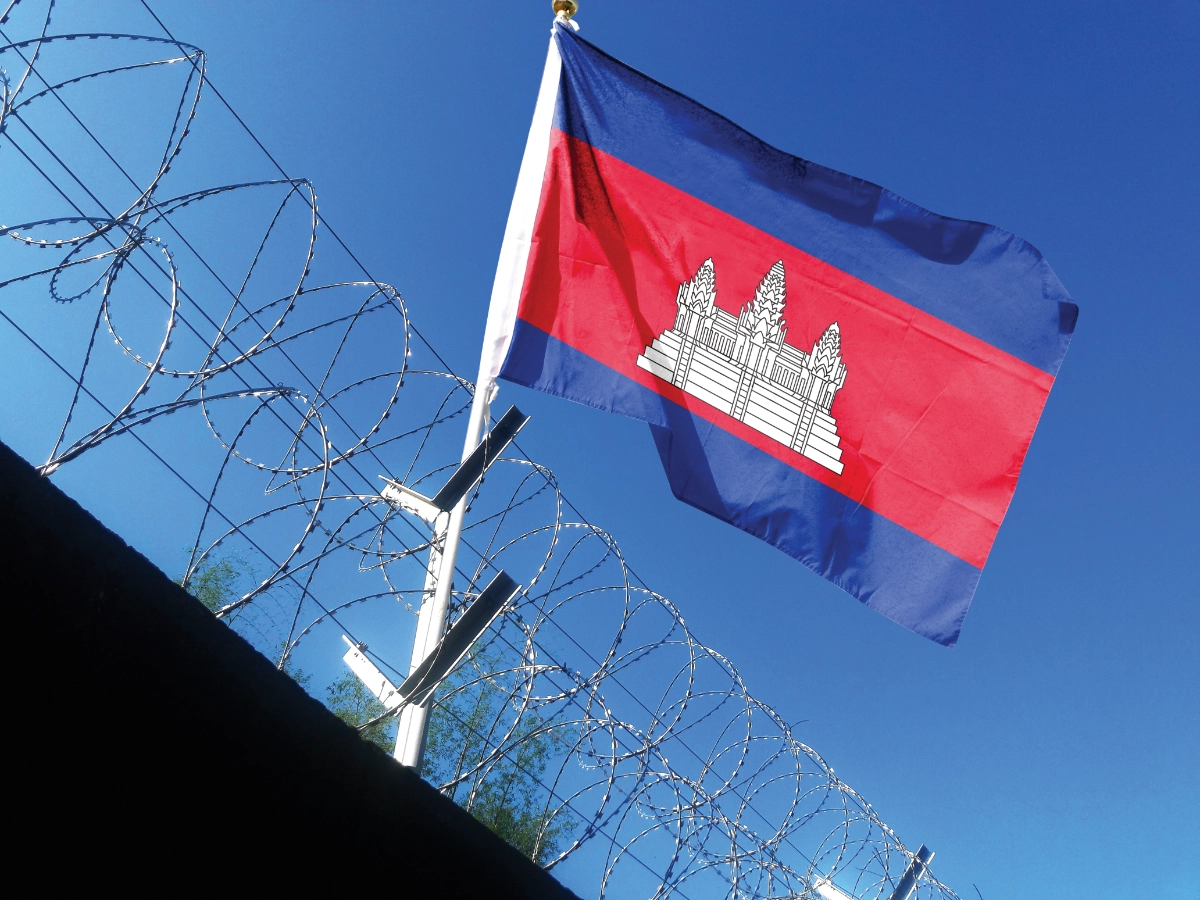

What is Cambodia doing to eradicate the country’s scam hub problem, and what does the path to success in this regard look like? IAG takes a closer look.
Cambodia has taken a massive tourism hit recently, with visitor numbers in the first five months of 2026 down by 47.8% year-on-year due to the border conflict with Thailand and the ongoing fight to eradicate scam compounds. And it is the scam issue that shapes as the greatest challenge amid rising international pressure to take action and the negative publicity this has created. But there is hope on the horizon.

RISING ABOVE
Cambodia’s Prime Minister, Hun Manet, has lamented that the nation is in a “war to restore reputation,” saying that the country is disproportionately associated with online scam hubs, despite their proliferation in the region and around the world.
Numerous reports from Amnesty International and other authorities have highlighted the alleged extent of the crimes committed in scam compounds while criticizing links between casino properties – both licensed and illegal – and fraud operations.
But headlines can also unfairly portray real effort, say insiders, and the extreme pressure brought down on Cambodian authorities by international powers – in particular China, which doesn’t want its citizens running (or being hurt by) the scam operations – is having a real effect.

Speaking to IAG, Daniel Li – a gaming consultant and former Advisor of the General Secretariat, Commercial Gambling Management Commission (CGMC) of Cambodia – praises Cambodian authorities’ multi-pronged approach.
“The closure of suspected locations, action against major alleged organizers and the revocation of casino licenses demonstrate that the government is treating this as a national security, law-enforcement and regulatory priority,” Li lauded.
Cambodia’s casino regulator, the CGMC, has also emboldened its approach, seeking international support to benchmark its own efforts and improve oversight, in mid-July even meeting with Australia’s Victorian Gambling and Casino Control Commission (VGCCC) as part of a study tour of one of the world’s most regulated casino markets.
This isn’t new; the CGMC has been touring other jurisdictions since (and before) formalizing its casino licensing and regulatory framework via the Law on the Management of Integrated Resorts and Commercial Gambling (LMCG) in 2020. Cambodia has continued to push for even more updated regulation, and while navigating an economic downturn and with major concerns over how the country is perceived.
But this year has been especially important for impact. In April, reports indicated that 91 casinos linked to scam compounds had been closed. In mid-July, authorities said 16,000 people had been recently deported over scam links. Hundreds of thousands of foreigners have also departed the country voluntarily amid the crackdown and tightening of regulatory oversight. And authorities pledge more.

LEGITIMATE OPERATORS LEAD THE CHARGE
So, are these efforts now laying the groundwork for something more stable? And what should Cambodia be focusing on next?
Li notes that, “For the gaming industry, the crackdown should be viewed as an opportunity for renewal. Cambodia’s future should be based not on the number of casinos it licenses, but on the quality, transparency and compliance of those operators. A smaller and better-regulated industry, focused on legitimate tourism and integrated-resort development, would be more sustainable and better protect Cambodia’s international reputation.”
The approach that these IR operators take in proving an elevation of their own standards, regardless of jurisdictional mandate, could prove highly beneficial in the long run.
The nation’s only real IR, NagaWorld, which holds a monopoly on casino gaming within a 200km radius of its Phnom Penh location, has followed that route for decades, with industry insiders saying that its approach to compliance even helped lay the framework for structuring the country’s AML standards and creation of fiscal oversight bodies. It goes far beyond merely not cutting corners, when a casino operator imposes self-mandated oversight that is far more robust than any yet implemented in a jurisdiction still writing its rules.

This was evidenced by the nation’s removal from the Financial Action Task Force (FATF) gray list in 2023, with the Philippines also similarly removed from the list (due to significant efforts on both land-based and online gaming operations), while neighboring Vietnam and Laos are both gray listed and Myanmar is black-listed.
Even under improved regulations, new operators are seeking to adhere to international standards of their own accord, with Kompong Dewa Resort Sihanoukville choosing proximity and contact with the regulator as a key building block.
The property’s Corporate Chief Marketing Officer, Lorraine Koo, told IAG that the group even has a dedicated “CGMC office that is located on the 2nd Floor of our main casino.”
Compliance with “audits, KYC and AML regulations that is in accordance with International Standards” is a hallmark of an IR mindset that prefers longevity.
The executive highlights how, in her view, even though “It might take some time for the government’s execution to be seen and reported in the international media,” work by operators in concert with authorities reinforces her on-the-ground reality: “The streets are safe, people are going about their lives as per normal: shopping, partying and working. Just like any other city in the world.”
 WHERE DID THE PROBLEM STEM FROM?
A natural target for the origin story of the proliferation of Cambodia’s scam compounds is its brief flirtation with legal online gaming, resulting from a dire economic situation and the strong appeal of new revenues. Online gaming was regulated between roughly 2015 and 2020, and this had a significant impact on the nation’s reputation, but largely due to conflict and crime.
However, a top former US Federal law enforcement official told IAG that the banning of online gaming operations in the nation, effective from 1 January 2020, wasn’t necessarily a catalyst for the current situation.
“Chinese groups, which dominate the online scams, would set up in a location – be it Laos, Myanmar, Cambodia. Why? Because they could. They either had a nexus, or they were paying off local officials or law enforcement. And the bottom line is they were able to operate with impunity, and they would do that whether or not there was legal online gaming.”
A recent report by the Asia/Pacific Group on Money Laundering found that the growth of cyber scam hubs across Southeast Asia has been largely anchored around Special Economic Zones in Cambodia, the Philippines, Myanmar and beyond. It also drew a direct link to the COVID-19 pandemic, which saw many casinos and hotels that were operated by criminal syndicates within these zones no longer able to generate sufficient proceeds through normal operations, due to lockdowns. These casinos and hotels were therefore repurposed into cyber scam hubs populated by human trafficking victims coerced into conducting scams.

The former US Federal law enforcement official told IAG that without the entire eradication of corruption, there can be no guarantee that nefarious activity will not proliferate – although one defense mechanism could be to resume the regulation of online gaming.
But this also raises the question of execution. Oversight authorities in the Philippines lamented the severe limitation of their efforts to eliminate bad actors in the Philippine Offshore Gaming Operators (POGO) era, due to the way that authority was distributed to multiple agencies, how they cooperated and what powers were ultimately granted to each group. The challenges were such that the Philippines eventually shut down the POGO industry entirely – providing a pathway to eliminating the illegal scam hubs that were using POGO licenses as cover.
Sri Lanka has also faced questions in recent committee debates over both its new online gaming legislation and casino legislation, with severe doubts as to whether the nation is capable of keeping its new system in check, or collecting the tax revenue that was the original rationale for introducing new gambling legislation last year.
Sri Lanka says that though it has no licensed online gaming operators as yet, there are already reports of scam compounds being established in the territory, and authorities are duly concerned. What happens next will be critical.

GUIDELINES TO SUCCESS
This issue can only be tackled through eliminating corruption, the former US Federal law enforcement official told IAG, although he offered praise for those Asian jurisdictions that are pushing for regulation over prohibition.
“Most policing in Asia is more militaristic, maintaining order and control. They don’t have as much conditioned experience in investigation and compliance,” laments the expert. He noted that improving those compliance enforcement powers requires the importation of international know-how and resources, as with Cambodia’s recent experience of asking China to intervene and the US to sanction bad actors. The country actively called out for such support and received it.
Limiting the overall number of gaming licenses, whether for land-based or online activity, can also be a strong regulatory tool.
“When you set up guidelines, when you set up due diligence, when you set up conditions for suitability – all those types of things that are known in European (operations) and are sometimes over the top for Western casinos (in Asia and elsewhere) – you will end up with a different environment,” notes the expert.

Cambodia is undoubtedly striving to raise its standards, both to enhance its standing within the international community and to secure the long-term sustainability of its gaming industry. It has already benefited from the regulatory frameworks voluntarily adopted by those operators committed to higher standards. Now, the industry is looking to the government to strengthen Cambodia’s tourism reputation and ensure those investments translate into a sustainable and prosperous future.
As the US lawman points out, troubled times tend to be cyclical in nature, giving confidence that Cambodia can move beyond its current experience and regain credibility on the global stage as an attractive tourism and gaming destination.













