




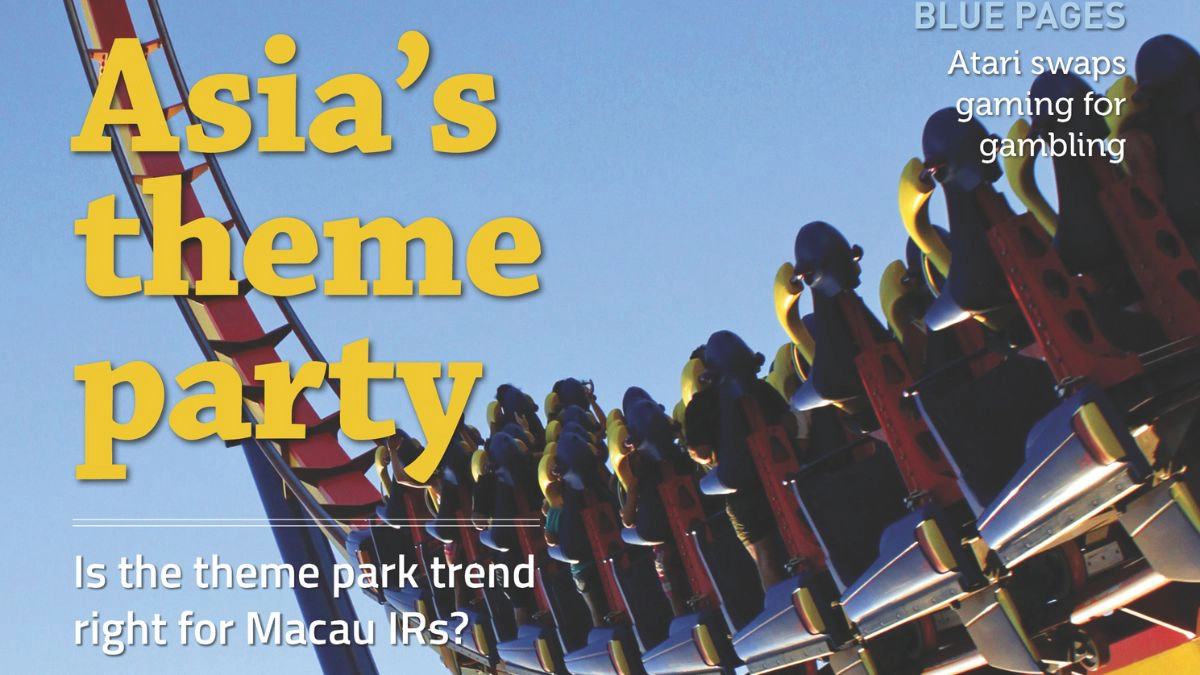

In this regular feature in IAG to celebrate 21 years covering the Asian gaming and leisure industry, we look back at our cover story from exactly 10 years ago, “Betting on family fun,” to rediscover what was making the news in August 2016!
The theme park concept that has proven so successful for some integrated resorts across Asia has never been adopted in Macau, but the discussion, typified by two conflicting schools of thought, has been ongoing for well over two decades.
 Proponents of theme parks argue that they perfectly align with the Macao SAR Government’s efforts to diversify the economy by providing more family-friendly attractions that appeal to the region’s rising middle class.
On the flip side, detractors question whether family-friendly attractions are appropriate for a city so centered on casino gaming – especially given that investment in a large-scale theme park would undoubtedly come from one or more of Macau’s existing concessionaires.
This conflicting ideal was the basis for IAG’s cover story in August 2016, “Betting on family fun,” which asked the question whether Macau should view theme parks as the way of the future or leave such flights of fancy to neighboring Hengqin and Hong Kong.
“I’m not that sure family entertainment and casinos are a good mix,” said Wynn Macau Director and Chairman of Hong Kong’s Ocean Park, Dr Alan Zeman, in comments to IAG at that time. “I believe those kinds of activities are better off on their own. It’s a totally different customer … a total divergence of customers.” However, the Innovation Group’s International Executive Vice President David Rittvo put forward a different argument.
“The customer profiles for theme parks and casino resorts may not be similar in terms of core participants or targeting segments,” he stated. “[But] by having theme parks and other family entertainment amenities, casino resorts will be able to diversify their offerings to capture a broader range of customers, various age groups, distinctive preferences and more.”
A decade on, Macau’s integrated resort operators have resisted any temptation to go the theme park route, although they have tested the water.
Melco’s Studio City, famous for its figure-eight observation wheel and impressive water park, is an exemplar, while Sands Cotai Central – the predecessor of The Londoner – once housed a high-tech indoor adventure park called Planet J.
 SJM’s Co-Chairman and Executive Director Angela Leong proposed a theme park alongside Cotai’s Grand Lisboa Palace at the site now known as Lisboeta.
And Galaxy Entertainment Group has toyed with the concept on multiple occasions during the phased development of Galaxy Macau but has ultimately opted for individual family attractions like its Grand Resort Deck instead of a full-scale theme park.
That’s despite some suggesting the Galaxy Macau property would be the perfect home for such a facility.
“A theme park could be a sweet spot for Galaxy – the family spends the morning at the theme park and afternoon at the pool,” said Union Gaming Securities Asia Managing Partner, Grant Govertsen.
“It gives them a tool kit to keep people on the property all day. There’s a bunch of people next door [at Venetian, Studio City and Parisian] and a theme park could be a way to get them to cross the street.”
As IAG noted at the time, the big question is whether Macau makes geographic sense as a global or Asian theme park destination.
Bloomberg Intelligence Gaming and Lodging Analyst Margaret Huang was never a fan, stating, “Theme parks may be a challenge for Macau, given Hengqin’s development of Ocean Kingdom next door.” Ocean Kingdom, she noted, was Asia’s most popular theme park outside Japan in the year prior (2015), ranking 13th globally and attracting nearly 7.5 million visitors.
“Competing in this space may not be the best strategy for Macau, given the possible saturation of theme parks in China with a pipeline of attractions,” Huang said.
Global Market Advisors Senior Partner Andrew Klebanow agreed, pointing to the presence of US$5.5 billion Shanghai Disneyland, Beijing’s Universal Studios and China’s homegrown Chimelong, OCT Parks and Songcheng Worldwide – all ranking among the world’s top 10 most popular theme park groups.
 “Why would I want to go to Macau for a theme park experience when there is a perfectly acceptable, internationally branded theme park an hour away in Hong Kong?” Klebanow asked – a reference to Ocean Park. “Do you think my niece would find meeting a fluffy panda superior to getting a hug from Sleeping Beauty or Mickey Mouse? Oh, and that Hong Kong theme park happens to be one train stop from one of the greatest airports in the world.”
While theme parks such as SkyWorlds at Resorts World Genting in Malaysia and Universal Studios at Singapore’s Resorts World Sentosa have been hugely successful, industry commentators also noted that these were markets where locals gaming was restricted in one way or another.
And Macau, at just 33 square kilometers, has the small issue of space to contend with.
It’s for this reason that individual theme park-style attractions like Melco’s Studio City Water Park and Wynn Palace’s SkyCab cable cars have been preferred over any larger-scale developments.
As then CLSA analyst Aaron Fischer said back in 2016, there’s “not a huge downside” to smaller scale attractions. “The amount of space and cost is quite nominal,” he said. “It’s something the government would like to see. It gets visitors to stay longer. Someone will gamble.”













