
Poker may well be the most divisive game on the casino floor. From an operator perspective, is the foot traffic poker can drive enough to cover its revenue challenges? And do players spend as much time on slots and traditional table games as they do at the poker table? IAG takes a closer look.
It’s one of the oldest arguments debated in casino boardrooms the world over: to run a poker room or not to run a poker room?
 The question of “value” as it applies to poker operations has never been straightforward. While it is understood that the game of poker does not generate revenue at anything like the rate of traditional table games or slots, those who support its presence on the gaming floor point to other factors – some quantifiable, some less so – such as its ability to drive other gaming activity, fill hotel rooms or simply generate excitement on the gaming floor thanks to the additional footfall it provides. Others, particularly those in casinos with limited floor space, argue that the area is better utilized by products that offer the greatest yield.
The issue is further complicated by jurisdiction. It is, for example, harder to justify poker in a city like Macau, where poker tables are included under the government’s strict table cap, than in the Philippines where no such cap exists.
And what value do you prescribe in a country like Australia, where poker is one of the very few forms of gambling casino operators can legally promote?
These are difficult matters to answer, so let’s start by addressing the elephant in the room: the question of profitability.
 On a standalone basis, poker can be and often is a profitable game. But the level of profitability is limited by the nature of the game itself. Unlike traditional casino games such as blackjack or baccarat, poker offers the operator no house edge, because players play against each other rather than the house.
The casino instead makes money by charging “rake” on each pot played, provided that pot exceeds an established minimum. For example, an operator might charge 10% rake capped at $5 on all pots of $10 and above. Under these circumstances, any pot under $10 would not be subject to any rake, while a pot of $30 would see $3 taken out for the house and a pot of $50 would be subject to a $5 rake. Anything above $50 would still see only the maximum $5 rake taken.
The rake charged by an operator is discretional but may be influenced by operational costs like dealer wages, which is why many casinos in the United States – where wages are subsidized by tips – can offer competitive rake structures, while those in Australia – where minimum wage and penalty rate requirements are extremely high – have been forced to raise rake in recent years.
The balance therefore isn’t so much about whether poker is profitable but whether it is profitable enough to justify its presence on the gaming floor.

Anthony Lucas, a professor of casino management at the University of Nevada, Las Vegas (UNLV), believes poker will always struggle to merit its existence when more obvious alternatives are available.
“Does it make money? Yeah, at around 20 tables, you can do pretty well,” he explains. “In fact, if you look at the margin, you can have a 50% departmental profit margin on poker. But let me put it in context. That 50% margin might be a US$3 million bottom line, which sounds pretty good until you look at slots which made US$125 million on a 65% margin.
“That’s why poker often gets pushed out for more slots [or tables]. It’s not that it isn’t profitable, and it’s not that there is no margin – it’s the profit per square foot.”
That so many casinos around the world continue to offer poker despite this profitability paradox often comes down to what Lucas first described in a 2008 research paper as “full service theory,” which asserts that the presence of a poker room (or other amenities like restaurants) increases wagering volume on both table games and slots.
This theory, he explained in an ensuing 2013 research paper, is “often used to justify the existence of an amenity which is failing to produce sufficient direct profits. The justification usually takes the following form: while it may be obvious the amenity is unable to demonstrate acceptable operating profits, eliminating it would cause a decline in critical gaming volumes such as slot and table game play.”

In reality, multiple studies the professor has since conducted across various properties in Las Vegas in the years since have found that poker does no such thing.
The results of that 2013 study, titled “Examining the Link Between Poker Room Business Volume and Gaming Activity in Slot and Table Games: A Closer Look at a Key Assumption in the Full Service Theory,” were published in the UNLV Gaming Research & Review Journal in May 2013.
Lucas used time-series regression analysis across 217 consecutive days of casino performance data at three Las Vegas casinos, then converted these to natural logs to stabilize variance and better model the relationship between poker play and slot or table game business. Of six tests conducted, only once did poker activity show a statistically significant positive relationship, with a 1% increase in poker rake being associated with a 0.09% increase in table-game drop. In the other five cases, the relationship was statistically indistinguishable from zero.
The “results from three different Nevada hotel-casinos failed to support the popular notion that poker rooms drive business to the slot and table game areas of the casino floor,” Lucas’s 2013 paper states. “This result not only questions the validity of a key and somewhat bold operating assumption, it casts a shadow of doubt on the broader Full Service Theory, as applied to the casino floor.”
In comments to IAG, Lucas said he has rarely seen any meaningful crossover on tracked play – although this isn’t exclusive to poker.
“It could be blackjack, it could be craps, but what we see is that craps players play craps, blackjack players play blackjack and there’s very little meaningful crossover on tracked play,” he said.

“Likewise, if you’re a proper player, you play poker. Why would you be interested in slots? They couldn’t be more different. [Slots] are super expensive with no skill involved versus a game that is super cheap with plenty of skill involved.”
Despite this, Lucas notes that there is “always context in social sciences,” and as such there are almost certainly specific circumstances where poker operations make undeniable financial sense. This could be as simple as using convention space rather than gaming floor to run a major tournament series like the World Series of Poker (WSOP), held each Las Vegas summer at the Horseshoe and the Paris, or the WPT World Championship held at Wynn Las Vegas each December.
Such tournament series are, of course, a different matter altogether, and it is notable that Asia has seen a resurgence in the regional tournament scene post-COVID via the likes of the Asian Poker Tour (APT), Asia-Pacific Poker Tour (APPT), the WPT and high-roller tour Triton.
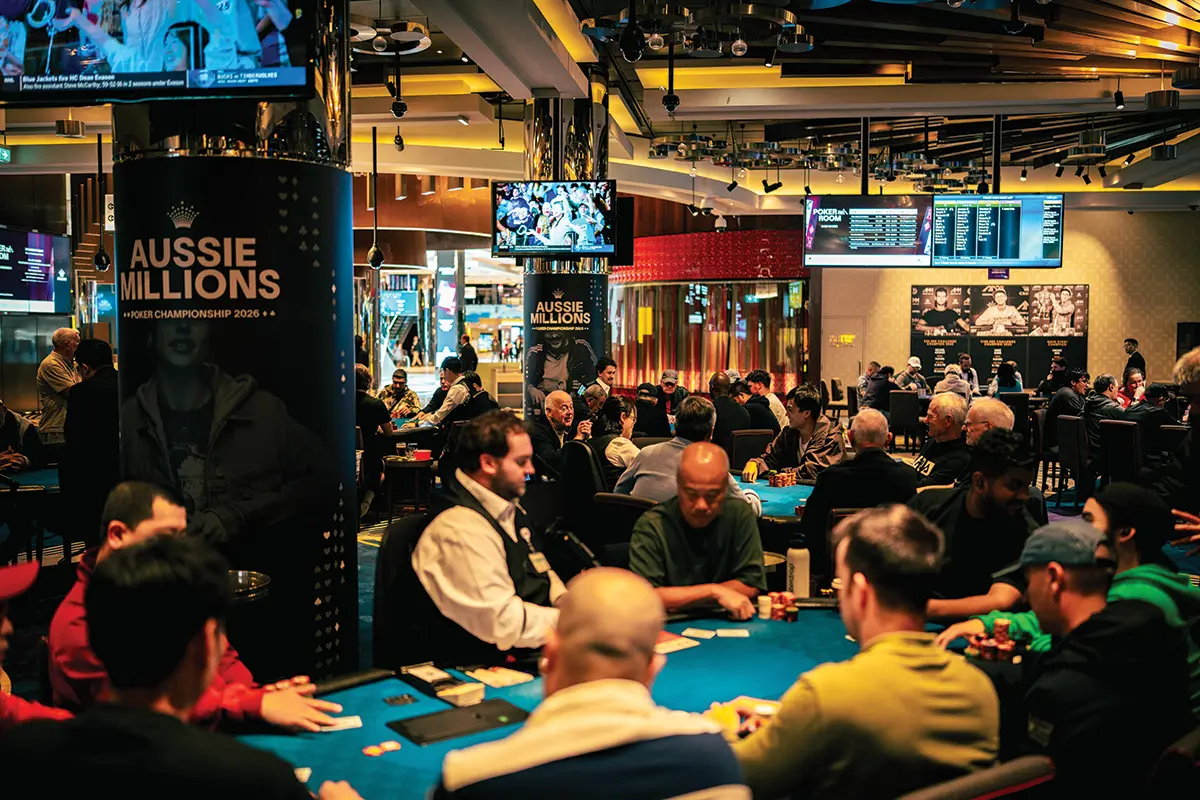
In late April of this year, Crown Melbourne brought back for the first time in six years the Aussie Millions Poker Championship. Once considered among the most prestigious destination tournaments anywhere in the world, the Aussie Millions had been paused after 2020 due to the COVID-19 pandemic and some well-publicized regulatory obstacles Crown needed to navigate in the interim.
The decision by the Crown management team to revive the series after such a lengthy hiatus was carefully considered, and when the announcement was made, keen observers noted a change of seasons from its traditional January slot to a new schedule in late April and early May.
The reasoning was simple. In January, the Crown complex was already bustling with guests in town for the Australian Open tennis, the cricket or simply to enjoy the peak of the Aussie summer.
April and May, on the other hand, are typically shoulder months with fewer hotel room bookings and a relatively quiet social calendar across the city.

Explaining Crown’s rationale, the company’s Executive General Manager of Table Operations, Harold Tsakmaklis, told IAG, “No disrespect to my predecessors that ran the Aussie Millions in January – they did a great, great job – but I feel it was masked by the Australian Open, Chinese New Year and the lead up to the [Formula 1] Grand Prix (held each March in Melbourne). So, when you’re trying to see where the direct benefits are coming in from Aussie Millions and poker, it’s really hard to peel the layers away.
“Plus, the Aussie Millions is big enough to stand on its own, so we’ve made a good decision here. We’ve chosen a shoulder period where there wasn’t much going on around the property, and it is much easier now to see the uplift [the Aussie Millions] has brought to the complex.”
On exactly where that uplift is most visible, Tsakmaklis points to strong hotel bookings while giving special mention to Lumia Bar – located alongside the poker room – which set an all-time sales record during the series.
“Poker in Australia has a huge following, so as a gaming operation the demand is there – we just need to make sure that we have the right product that meets our commercial objectives,” explains Tsakmaklis, who previously spent two decades as a gaming executive in Macau, most recently as Vice President of Casino Operations for Sands China.
 “To be fair, there’s a compromise there, because poker doesn’t yield as much as what you see on a baccarat table, but it has many other benefits. I think we are also in a discovery phase to see what those other benefits are that poker brings – not just a commercial aspect to the organization but what else does it drive within the complex?
“We’ve seen positive signs [during the Aussie Millions] with uplifts to F&B, hotel and just the complex in general, and I expect to see a positive P&L review after this, but it’s a little bit different to what most Macau executives would say about poker.”
Macau is indeed uniquely challenged when it comes to poker due to the Asian gaming hub’s table cap system, which limits the total number of casino gaming tables allocated for use across the city’s six concessionaires to 6,000. Poker tables are included under the cap.
It is for this reason that most operators have either never offered poker or have opted to replace previously existing poker rooms with higher-yielding games – typically baccarat. In fact, only two properties – The Venetian Macao and MGM COTAI – currently boast poker rooms, and their combined 46 tables represent just 0.77% of the 6,000 gaming tables in the market as of 31 December 2025.

Despite this, MGM launched the MGM Poker Tournament Series in 2024, boasting a HK$1 million (US$127,590) guarantee, and has held at least half a dozen series since with guarantees rising to HK$11 million (US$1.40 million) for the most recent series in March of this year.
Kenneth Feng, MGM China’s CEO, told IAG that offering poker fulfils a number of important criteria, including greater appeal to international guests – a core stipulation of the Macao SAR Government when it issued new 10-year gaming concessions in late 2022.
“Poker has been steadily rising for us in recent years, and it helps us elevate our premium positioning, enhance our brand recognition and demonstrate our professionalism – our credibility in the eyes of players,” Feng explained.
On their profitability, he added, “We only have around 20 poker tables out of over 750 in our total table inventory, but even these 20 tables provide us pretty meaningful financial return.

“We have over 50,000 square meters of gaming space [across the company’s two IRs: MGM COTAI and MGM MACAU] and of course win per table per day is higher [on other games] than how much we can make on poker, but that doesn’t mean we cannot get a reasonable EBITDA return – profit return – on the poker offering.
“In general, we really look at poker as an overall balancing strategy. We are trying to help attract more international visitors to Macau, and I think it is our responsibility to continue to do that. And as I said, from a branding and credibility position for our properties, I think these are all definite considerations for a balanced way of thinking.”
David Croft, SVP Gaming Optimisation and Strategy for gaming optimization software company Tangam Systems, spent almost 17 years with Australian casino operators Crown Resorts and Star Entertainment Group and was instrumental in setting up the poker offering at Star. This included establishing partnerships with the WSOP and WPT to run major branded tournament series at the company’s Sydney and Gold Coast resorts.
Asked for his thoughts on the question of poker’s value to an organization, Croft told IAG, “A well-run poker operation will add value to operators in several ways. Firstly, through direct revenue driven by poker cash games, poker tournaments and the on-spend of poker players across other casino games, F&B purchases and hotel stays.

“Secondly, poker affords the opportunity to add atmosphere to a casino, and as poker is a destination product, it can be used to activate underutilized floor space. Finally, poker affords great branding value for casinos.”
However, he also warns that the decision to pursue a poker strategy should be carefully evaluated in the first instance to ensure its output aligns with the operator’s goals. Key questions include whether poker runs profitably as its own business when taking into account labor, marketing, tournament costs and specialized staffing; if it is the best use of floor space and table count; whether it represents the best use of labor where staff resources may be constrained; and where the real value lies in utilizing tournament poker to bring atmosphere, excitement and brand positivity to the casino floor.
Croft, for his part, agrees with Professor Lucas’s assessment on the lack of significant crossover play but counters “every dollar of revenue counts.” He adds, “Reducing the table count to include poker tables can be offset by ensuring dynamic pricing is in place to match demand with supply and maximize profit from non-poker (other table games), whilst still enabling poker to be part of the broader offer.
“It is important to remember that if there is no poker, the money that would be spent by poker players generally will not get spent on other gaming at the venue. Operators will lose the customers and lose the revenue.
“Overall, casinos provide a safe professional environment for players to test their skills against a variety of people – a well-managed and strategically positioned poker operation will be a positive for operators.”