
While Macau’s integrated resort retail sector is soaring, small community businesses are facing a crisis, as locals increasingly travel across the border to take advantage of mainland China’s extensive and cost-effective shopping options. IAG looks at how this is impacting local retailers.
Three years since Macau’s border fully reopened, gaming revenue and visitor arrivals have staged a strong recovery, with arrivals even surpassing pre-pandemic levels.
 At the same time, however, deep integration across the three Greater Bay Area cities is profoundly reshaping Macau’s local community economies. The question arises: will the slump in Macau’s neighborhood economies persist, or has this shift already become an irreversible new normal?
Unlike Hong Kong, cross-border consumption in mainland China is commonplace among Macau residents. A clear division of consumption patterns has long existed between Macau and Zhuhai: Macau generates household incomes, while Zhuhai offers more affordable daily living options.
That dynamic has undergone dramatic shifts in recent years amid changing economic conditions and policies such as the “Macau Vehicles Entering Mainland” scheme, which has drastically cut the time and psychological barriers to cross-border travel. The launch of iris recognition self-service clearance at the Border Gate checkpoint has further streamlined immigration formalities, trimming processing times by one to two seconds for contactless self-check-in and enabling near-seamless travel between the two cities. What was once a supplementary habit of shopping across the border has gradually become part of daily life for many Macau households.
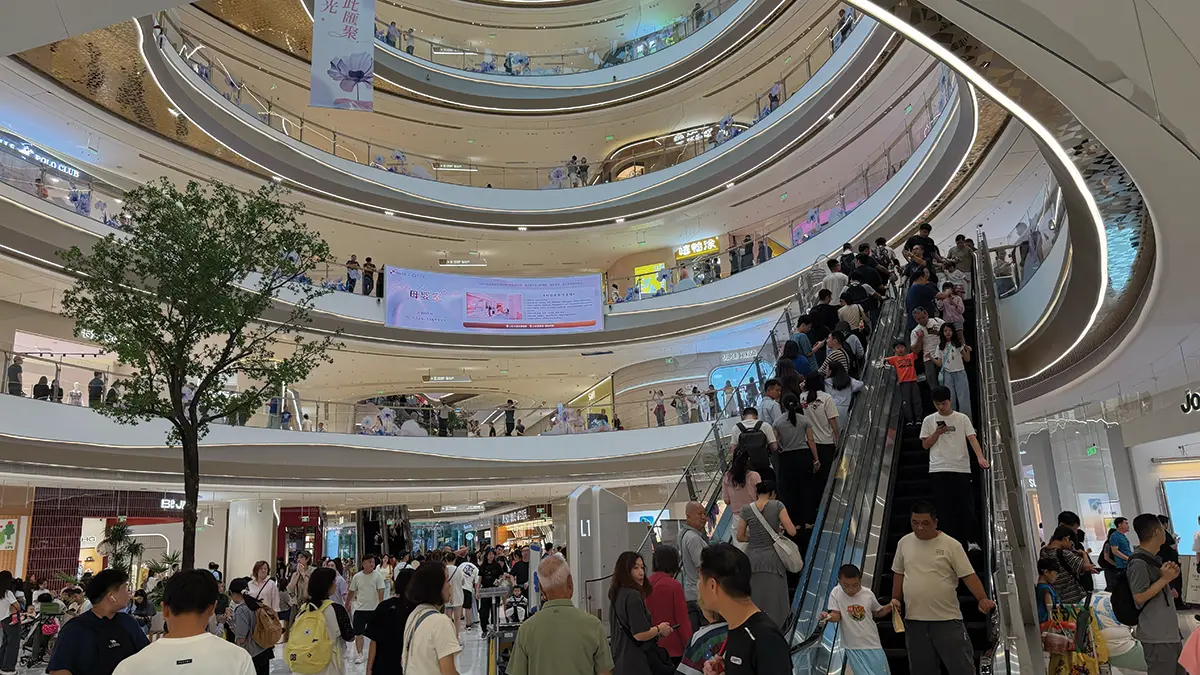
 Large shopping malls have recently opened near Zhuhai’s border crossings to capture the flood of cross-border shoppers. Take the Guanghehui complex at Zhuguang International Mansion, adjacent to the Gongbei Checkpoint, as an example: over 100,000 visitors were recorded within the first six hours of its soft opening, around one-third of whom were residents of Hong Kong and Macau. Behind this figure lies a stark reality: Macau residents’ spending habits are rapidly shifting northwards into mainland China.
Local retailers catering primarily to Macau residents have borne the brunt of this shift, and the economic model sustaining Macau’s neighborhoods appears to have undergone a fundamental transformation. Industry insiders note that business troughs now fall not on weekdays but on weekends and public holiday periods that were once peak trading days.
Kelvin, who runs a pub restaurant in the Northern District, is one of the merchants experiencing this paradigm shift firsthand. Having operated through the pre-pandemic, pandemic and post-reopening eras, he describes the present climate as the toughest yet.
 “During the pandemic, Macau residents spent locally, bolstered by government consumption subsidies – trade was actually better than before COVID,” he explained. While the broader economy was sluggish back then, concentrated domestic spending provided vital support for many neighborhood food and beverage outlets.
The tide turned once full border clearance resumed. Kelvin said pent-up demand for cross-border trips surged once travel restrictions lifted, fueling a sharp rise in residents’ willingness to shop and dine in Zhuhai.
“Trade deteriorated steadily after the border reopened. Weekends and long public holidays are the worst; there have been nights where we only had one table of customers,” he said. For a pub restaurant that relies heavily on evening and holiday trade, such slumps equate to losing its core source of income.
 He added that he sometimes considers closing entirely over extended public holidays, as opening for business often fails to generate sufficient turnover – a complete reversal from pre-pandemic trends when holidays delivered strong sales. Kelvin believes this is no temporary fluctuation: a permanent shift in consumer behavior has taken root, unlikely to reverse in the short term and poised to become the new baseline for Macau’s community economies.
Industry sentiment aligns with broader retail consumption data recorded in recent years. Macau’s retail sector hit a post-reopening peak of MOP$86.3 billion (US$10.7 billion) in sales in 2023 before falling sharply to MOP$72.0 billion (US$8.92 billion) in 2024 and sliding further to MOP$69.6 billion (US$8.62 billion) for 2025. By comparison, total retail sales stood at MOP$77.2 billion (US$9.56 billion) in 2019, the last pre-pandemic year – meaning there has been a drop of nearly MOP$8 billion (US$991 million).
Visitor arrivals, by contrast, have climbed steadily. A total of 14,655,300 tourists entered Macau in the first four months of 2026, marking a year-on-year rise of 13.1%, with annual arrivals projected to exceed 40 million for the second straight year. Non-gaming spending by tourists reached MOP$24.4 billion (US3.02 billion) in Q1, up 24.5% year-on-year.
 This paints a picture of uneven recovery across Macau. Tourist zones, integrated casino resorts and associated high-end retail continue to benefit from rebounding visitor numbers, yet countless small and medium-sized enterprises dependent on local household consumption face sustained revenue losses rather than a post-pandemic upturn.
To ease pressures on community businesses, the Macau government has rolled out a suite of initiatives in recent years, including large-scale consumption incentive campaigns such as the “Community Consumption Rewards Scheme,” designed to encourage residents to spend within Macau and mitigate the impact of cross-border spending outflows on SMEs.
Casino operators have also been assigned an expanded role in revitalizing local neighborhoods. The Macao SAR Government continues to enforce non-gaming investment commitments laid out in casino concession contracts, pushing operators to host large-scale concerts, exhibitions, sporting fixtures and entertainment events to draw international tourists. Authorities have also urged gaming companies to support community deep-tourism routes, optimizing shuttle bus schedules to channel resort visitors into the Northern District and old town areas, in the hope of converting tourist footfall into tangible sales for local merchants.
 However, policy outcomes have often fallen short of expectations. For many SMEs, these visitor diversion measures are insufficient to offset the structural shift in consumer behavior. Local small businesses already struggle to compete head-to-head with large mainland shopping centers and national chain brands on rent, labor costs, operational overheads and physical store scale.
Mainland retailers leverage vast domestic population bases to drive volume sales and cut unit costs via chain operation models – a business dynamic fundamentally different from Macau’s small market, which forces local vendors to charge higher unit prices. After years of exposure to high-value, cost-effective consumption options across the border, Macau’s domestic mass market has become far less competitive for local operators.
Amid this seismic structural shift, business model transformation represents the only viable lifeline for local merchants. Another restaurant in the Northern District originally focused on evening street-food-style dining, but with persistent revenue declines, the owner pivoted last year to launch midday three-dish set meals – affordable plated lunches where customers select three side dishes to pair with rice – priced from as low as MOP$30 (US$3.72), targeting nearby residents and office workers.
Mr Wong, the restaurant proprietor, said he previously focused exclusively on evening trade, yet mid-tier catering has become increasingly unviable, prompting the strategic overhaul.
 “We simply cannot compete with mainland operators on rent, staffing and raw material expenses – there is no way to match their cost base,” Wong stated. In this operating environment, low-cost mass catering still retains a niche in Macau’s market; while profit margins are squeezed, the model delivers modest sustainable returns, outperforming the traditional dining format.
He argues local merchants have limited room to alter broader market forces.
“We cannot change the macro environment – small catering businesses must adapt their own operating models instead,” he observed.
In his view, Macau’s food and beverage sector is growing increasingly polarized. One segment consists of low-priced mass-market eateries operating on thin profit margins and high turnover; the other comprises premium dining outlets within integrated resorts catering to high-spending tourists. Mid-tier restaurants that once served general families and middle-class households face a shrinking survival space.
“Macau’s catering industry now splits into two tiers: budget local eateries and high-end resort dining,” Wong said. “Mid-range restaurants catering to ordinary families can barely stay afloat.”