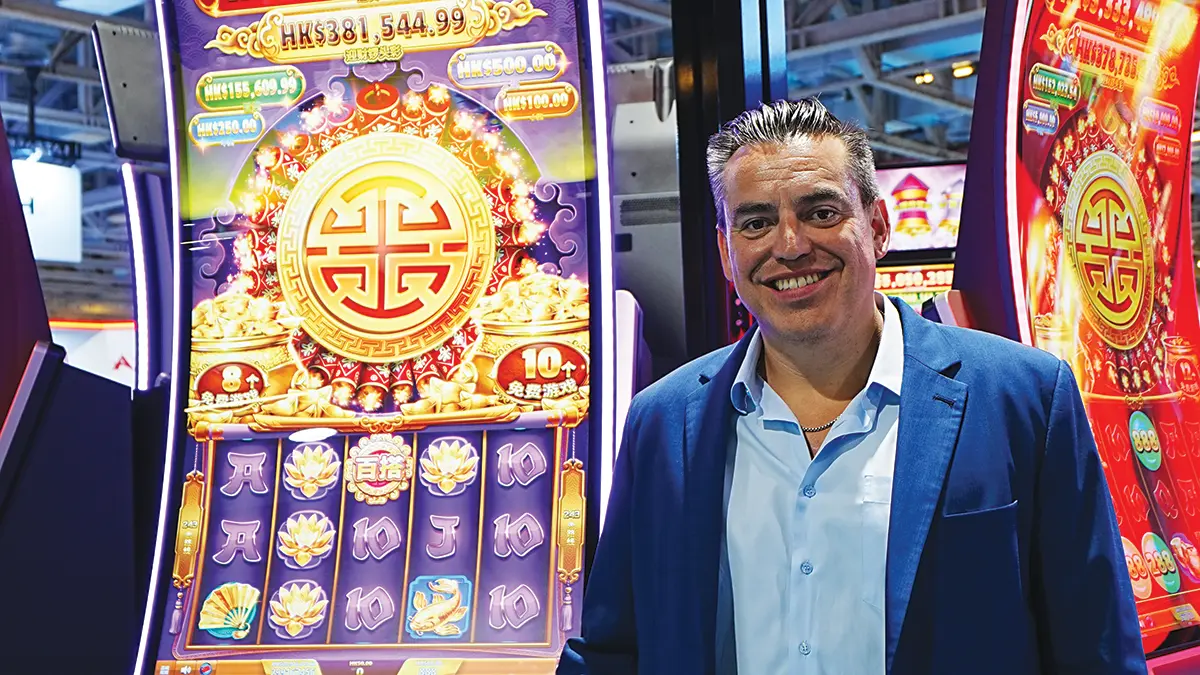

Having officially joined the new-look IGT as CEO in December, Hector Fernandez is setting out to restore this once dominant industry giant to its former glory – and he isn’t shy about how he plans to do it.
When Hector Fernandez was on forced leave last year after departing Aristocrat to join IGT, he travelled to Turkey and the ancient city of Ephesus – once a Roman Empire stronghold but now mostly ruins and rubble.
The experience was reminiscent of the situation Fernandez finds himself in at IGT, itself a historical giant of the global gaming industry but today considered a relic of the times. Yet, like Ephesus, while the contrast between the past and present is stark, strong foundations remain – a fact the former CEO of Aristocrat Gaming found strangely alluring as he pondered his seismic career move.
 “It was interesting because [at Aristocrat], IGT was a main competitor of ours, so as an outsider, I knew a lot about the company,” Fernandez recounts. “I knew a lot about the strengths and the weaknesses. I knew a lot about the history and the dominance that they once had in the marketplace. And I knew a lot about their downfall, because I had spent a lot of time talking to folks who were around the company at the time.
“I’m a big history person, and one of my favorite stories is the rise and fall of the Roman Empire, one of the longest-lasting empires ever with a thousand years in power. It’s always interesting to find out how you lose your way when you’re so dominant.
“As an outsider, I had a perspective on that in regard to IGT, but one of the things I also saw was that it still had all of the right parts, the right ingredients. It had just somehow lost the recipe and possibly a lot of the chefs to execute the recipe. So, it became very clear to me that this was a company that needed a turnaround but that executing this turnaround was manageable – something that could be achieved. That’s why I’m here.”
This year undoubtedly represents an inflection point for IGT, which in 2025 officially split from its lottery arm as part of a multi-billion-dollar acquisition of the company’s gaming and digital businesses by asset management firm Apollo. The new-look IGT, which incorporates fintech leader Everi – also part of the Apollo acquisition deal – has since been busy rebuilding its global leadership assets, with Fernandez its prize recruit.
 A finance and accounting executive by trade, Fernandez previously spent over six years with Aristocrat – the last three as CEO of Aristocrat Gaming – before agreeing to lead this new version of IGT in December 2024. He officially joined in December 2025 after completing a 12-month non-compete provision.
Fernandez likens his role to that of a sports coach, adamant that his skills and leadership experience are a perfect fit for where the IGT team finds itself at this point in time.
“I’m an ambitious person, and one of the things I was aware of coming into this business – and something everyone needs in order to be successful – was the personal life trade-offs,” he states. “Your ability and willingness to make personal sacrifices to make the business better is crucial, and I think, in a weird way, this job was designed for someone like me because I thrive in chaos.

“I’m also a very quick decision maker, which sometimes makes the team very uncomfortable. And I make decisions with imperfect information, because that’s how the world is.
“The other thing is that I’m very curious by nature. I’m always asking the why and really trying to always absorb information. I think the second you lose that curiosity, especially as a CEO, you’re destined to lose market share, because if you as a CEO aren’t asking questions all the time, it means your team’s not either.”
Fernandez has wasted no time stamping his mark on the business. In March, he sent an internal letter to all staff informing them of the “difficult decision” to slash roughly 10% of IGT’s global workforce. In the letter, he explained that these changes were required to “align resources with business priorities and streamline operations, ensuring we are best positioned for future growth.”
This followed the unveiling – at IGT’s first Town Hall meeting following his arrival in December – of a new “5C” concept aimed at driving the group forward: Culture, Capabilities, Content, Commercialization and Cash flow creation.
 And while he admits there is a lot of work still to be done, there have already been some early wins.
“One of the areas where IGT had lost its way was that it had become fairly bureaucratic,” he observes. “They would talk to each other but they stopped looking at the market and talking to customers.
“One of the first challenges as we brought these two businesses (IGT and Everi) together was, ‘How do we drive efficiency?’ Not just to save money, which is important, but to really drive speed of execution and empower the right people? That was one of the things we prioritized quickly, with the goal of taking a lot of those cash savings and investing them back into the business.”
 Fernandez also highlights “culture” as the single most important pillar of IGT’s “5C” strategy, because “you could have literally done all of those other things right, but if people hate coming to work, you’re not going to be effective.
“It’s very simple to me. If you hate getting up in the morning and coming to work, if you hate your job three out of five days, you need to find a new job. It’s not the right cultural fit for you. So that’s what we’re trying to do.”
On where he feels the most progress has been made among the 5Cs, Fernandez quickly comments, “We have a long way to go on all of them – although I would say the one we’re probably the furthest along now is cash flow creation, because we have driven a lot of efficiency. It’s the one you have to get right early because otherwise you destroy culture. But on the other ones, we still have a long way to go.”
Perhaps IGT’s greatest challenge lies in Asia-Pacific, where its market share across key jurisdictions like Australia, Macau and the Philippines remains far below that of dominant leaders Aristocrat and Light & Wonder.
 For Fernandez, the fact that he previously spent so much time in the region as head of Aristocrat Gaming only serves to drive home the scale of the task at hand.
“It’s this concept of being the hunted versus the hunter – and I’ve experienced both,” he laughs. “The good news is I’ve spent a lot of time in this market. Not just Macau specifically but the Philippines and Singapore, Australia, and I was fortunate to learn that this is not one market. It is a very nuanced market. And what works in the Philippines may not work in Macau, may not work in Singapore, may not work in Vietnam.
“So, I bring a lot of that background and experience to the market. Also, in my prior role [with Aristocrat] I learned that you need to drive guardrails in this market but then empower the team that’s here to make quick decisions, to do the right things, to be demanding on the product they need to be successful in the market.

“You hear a lot of people use the word ‘tweak’ but I hate that word because I really believe each market is very different, so you’ve got to rebuild games for each specific market.”
IGT won’t, however, look to flood the local market with dozens of games, instead focusing on “three or four hammer games” that can make an impact. That two recently released titles – “Rising Rockets” and “Money Gong” – are already performing well provides a solid base, although Fernandez makes it clear, “I can’t take credit for those. I was lucky to walk in and have two titles performing at a high level.
“As you know, you don’t need to come to a place like Macau with 20 games. Even if you have just one, that’s enough in this market.
“So, that’s one thing. The other is knowing where the talent is, and we’ve already had success in attracting some real A-level talent to the organization that will make a meaningful difference for the customer.”
 It comes as no great surprise that much of that talent is former Aristocrat alumni, with Inside Asian Gaming having recently broken the news that Lloyd Robson, until recently Aristocrat’s SVP for Asia and EMEA, and Ashley Fong, head of Product and Planning Strategy for Asia, will be on their way once they serve out their own mandatory non-compete periods.
On Robson, Fernandez says, “Lloyd has been in the market for a long time, lived locally [in Macau] and has a deep understanding of customers, where the market is headed and the regulations. I feel very fortunate that someone of Lloyd’s caliber was interested in coming here, and I’m very excited for him to show up.”
Fong, he adds, is a “product monster” who is “just so in tune on what works in every specific market. The combination of Lloyd’s customer relationships and Ashley’s product know-how will be critical as they come to me and the organization and say, ‘These are the things that we need to be successful in this market.’ My job is then to provide those things, and theirs is to execute on those things.
“But it’s been very humbling for me: the amount of people from other companies that want to come here.”
IGT’s Asia strategy is not unlike that for other parts of the world, Fernandez explains, noting that while bolstering the team remains important, honoring the company’s legacy should not be understated.
“We’re just infusing new talent and capabilities to truly take advantage of the things that IGT was always known for,” he continues. “I’m not trying to reinvent the wheel. We’re a third-place player here in Asia, and I have no dreams of being first overnight. We’re going to earn our way there.
“It will take some time, but we’re putting all the right ingredients together, perfecting the recipe and bringing in some new chefs.”
In a fitting ode to his reverence of history, Fernandez took another memorable detour shortly after he began his IGT journey – to the company’s sprawling 1.25 million square-foot manufacturing campus in Reno, Nevada.
 And as he walked the floors of this famous building where the IGT story began so many years ago, he was reminded of his trip to Turkey and the crumbling city of Ephesus
“I walked around and saw all of these legacy slot games that had been so popular back in the day, but knowing that it is no longer their heyday,” he recounts.
“And I remember thinking, ‘If we could build this back to the city of Ephesus, if we could bring it back not to 70% share, because that’s never going to happen, but to being competitive again, that would be a pretty cool legacy to leave behind.
“To bring this iconic brand that started a lot of what the industry has become to a competitive positioning, that would be a career highlight for me, for sure.”