
As post-pandemic tourism bounces back, Macau’s policy drive for non-gaming economic diversification has once again taken center stage in public discourse and on the political agenda. Three years on, how has the non-gaming sector evolved? And has the expansion of non-gaming businesses effectively lowered the share of gaming tax revenue in the government’s public fiscal income?
The Macao SAR Government has repeatedly pledged to pursue moderate economic diversification. Under the Macao SAR Development Plan on Appropriate Economic Diversification (2024-2028), authorities target lifting the proportion of non-gaming industries in local GDP to 60% and cutting the gaming sector’s share down to 40% by 2028.
 Nevertheless, actual economic data and urban development trajectories tell a different story. While Macau has rolled out various non-gaming initiatives and some integrated resort operators have hit record highs in non-gaming revenue, the gaming industry remains the unshakable core pillar of the local economy and public finances.
Gaming continues to be Macau’s most stable and dominant source of government revenue. In the first four months of 2026, Macau’s total recurrent government income stood at around MOP$40.3 billion (US$4.99 billion), of which gaming tax revenue reached MOP$34.87 billion (US$4.32 billion), accounting for 86.5% of recurrent income and 84.3% of overall government revenue.
For the full year of 2025, gaming tax revenue totaled MOP$94.9 billion (US$11.8 billion), making up 82.7% of total recurrent income and retaining its dominant position in public coffers, even surpassing the 2019 level.
Back in 2019, Macau’s total public fiscal revenue hit MOP$133.5 billion (US$16.5 billion), including MOP$105.8 billion (US$13.1 billion) in gaming taxes, which represented 79.3% of total government revenue.
 These figures clearly illustrate that government reliance on gaming revenue has seen no fundamental reversal, whether before the pandemic, during the tourism recovery phase or at present.
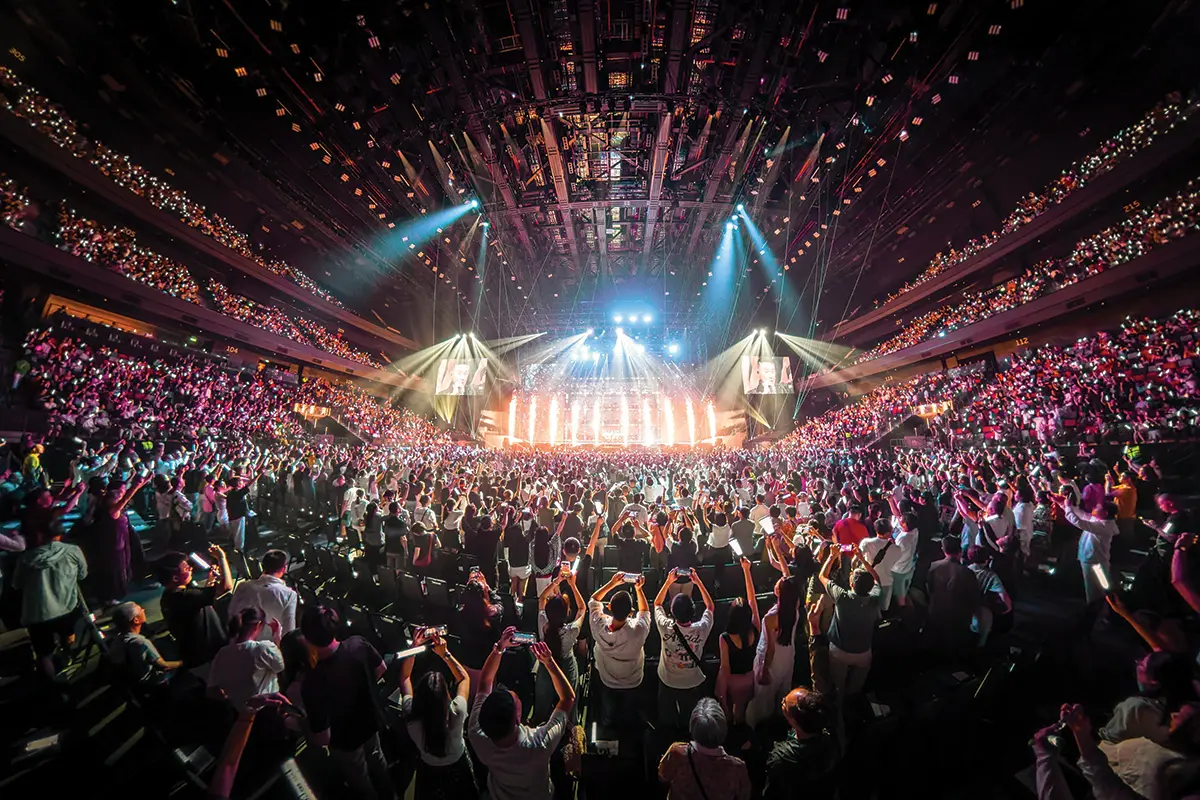
This is a commonly overlooked blind spot in discussions over non-gaming development. Macau is home to a wide array of non-gaming offerings, including mega concerts, sports events, MICE, hospitality, retail and themed entertainment. Yet these new ventures are still far from reshaping the overall economic structure.
According to the Second Five-Year Plan for Economic and Social Development of the Macao SAR (2021-2025), the share of emerging industries in total industrial value-added dropped from 18.6% in 2022 to merely 9.3% in 2024.
Whenever the gaming sector stages a strong recovery, the local economic structure tilts back towards gaming, quickly diluting the progress made in non-gaming development.
 A more pressing concern is that Macau’s predicament goes beyond an over-reliance on gaming revenue. The growth of non-gaming businesses itself is heavily hinged on local gaming concessionaires. Many landmark diversification projects in recent years – ranging from live entertainment galas, sporting events and cultural programs to community revitalization and old district renewal schemes – are largely backed by investments from gaming concession holders.
By urging concessionaires to ramp up non-gaming investment, the government aims to leverage their capital strength, venue resources and international operational expertise to transform casino-centric operators into comprehensive leisure enterprises and turn Macau from a gaming hub into a top-tier tourist and leisure destination.
This strategy has yielded tangible short-term results. The six major integrated resort operators have seen steady growth in non-gaming earnings, with their combined related revenue nearing MOP$38 billion (US$4.71 billion) last year.
The core flaw lies in the fact that Macau’s economic transformation is overwhelmingly funded, planned, built and customer-driven by gaming concessionaires. Such diversification is inherently ancillary in nature. Rather than fostering an independent, mature and self-sustaining non-gaming industrial ecosystem, Macau has only built an extended business ecosystem revolving around integrated casino resorts.
 Despite visible growth in non-gaming business volume, resource allocation, consumption flow and industrial development pace are still predominantly dictated by gaming concessionaires. This does not constitute genuine economic diversification, but merely an upgraded iteration of the existing gaming-based economy.
From a broader perspective, the root cause lies in imbalanced urban investment structure. Macau has long lacked large-scale independent third-party investors. Few market players outside the gaming concession system are capable of sustained investment and brand building across culture, sports, MICE, cultural and creative industries and district revitalization projects.
In short, Macau does have non-gaming businesses in place, but it lacks viable market entities that can operate independently of the gaming concession regime.
Instead of equipping rising non-gaming revenue with successful economic restructuring, the market ought to examine who generates such earnings and whether complete independent industrial chains have been established. Without solid independent industrial foundations, booming non-gaming consumption is nothing more than derivative spending derived from gaming-related foot traffic, insufficient to drive Macau toward genuine moderate economic diversification.
It is true that local integrated resort operators have evolved from pure gaming service providers into full-fledged leisure conglomerates covering hospitality, catering, retail, entertainment, MICE and sports business lines.
Even so, if Macau merely shifts its reliance from gaming revenue to gaming conglomerates, its underlying economic risks remain intact, only manifesting in different forms.
Macau has taken the initial steps to boost non-gaming development, yet it still has a long way to go to break free from gaming dominance. The crux of the issue is not whether non-gaming policies are enforced, but that such development is still heavily reliant on gaming concessionaires. Should local authorities continue to count on gaming firms to spearhead non-gaming expansion and rely on gaming taxes to underpin public finance in the years ahead, economic diversification will remain superficial, failing to bring about profound structural economic reform.