
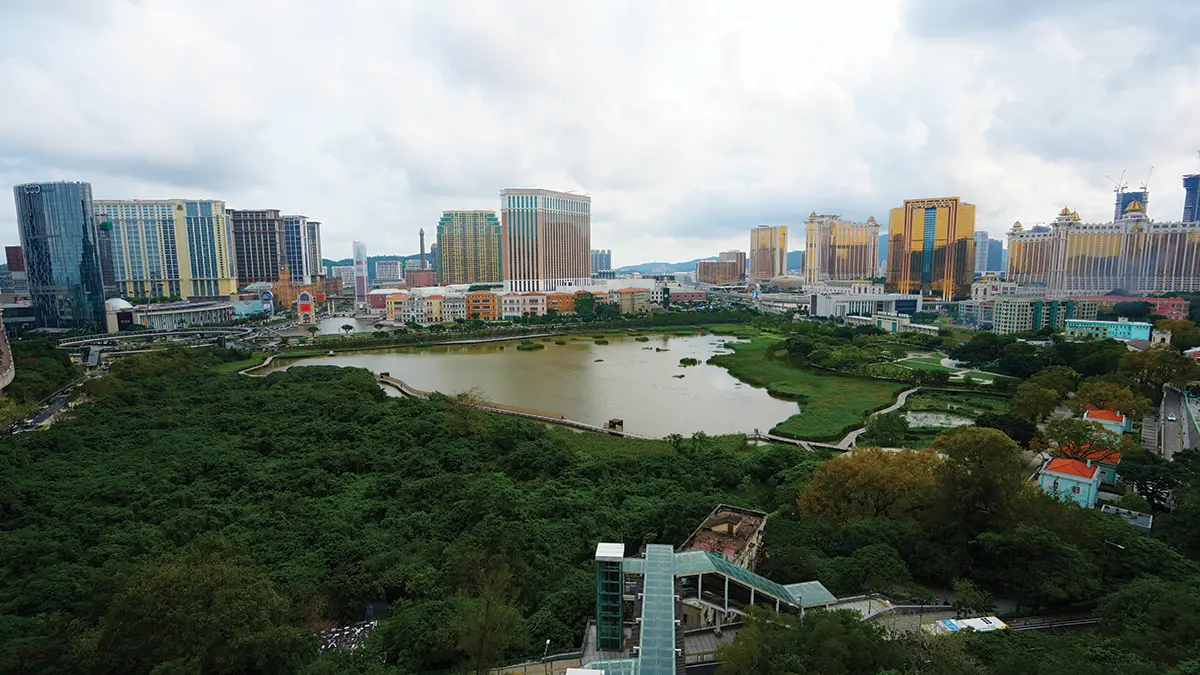

Inside Asian Gaming takes a closer look at the Macau gaming market as it stands in 2026, examining how the landscape has changed from a VIP-centric to a mass-focused model and why margins remain squeezed despite what should be seen as positive progression.
Macau has undergone a transformation. Once driven by the high-volume, low margin and extreme risk junket business, it is now an overwhelmingly (premium) mass driven town. And it is no longer home to the 42 casinos of its peak in 2015, but just 20 today – a consequence of the government-led transition away from the satellite casino model.
To put it bluntly, Macau is cleaning up its act in the post-COVID world; but is it better for it? That all depends on perspective.
 The world’s largest land-based gaming hub recorded gross gaming revenue (GGR) of US$30.6 billion in 2025, representing a healthy 9.1% increase over the prior year. It’s notable, however, that even to this day, many industry commentators continue to compare the city’s GGR numbers to 2019, when GGR reached US$36.6 billion. For the record, that leaves 2025 GGR down 15.4% compared to pre-COVID, and if we are to go back to Macau’s peak of 2013, down 31.4%.
But that doesn’t tell the full story.
One of the highlight stories of the COVID years was the collapse of Macau’s once dominant junket industry. In November 2021, Alvin Chau – then CEO of Asia’s largest junket operator Suncity Group – was among 11 people arrested by the Judiciary Police (PJ) as part of a mainland Chinese investigation into cross-border gambling. He was charged, and later imprisoned, for criminal association, illegal gambling and money laundering in a monumental move that ultimately led to Suncity officially ceasing its junket business.
 A near identical case was mounted against another of Macau’s most prominent junkets, Tak Chun Group, and its CEO Levo Chan in 2022 as Beijing made it clear that the days of the Macau junket model and its underground banking systems would no longer be tolerated.
To be fair, the decline of VIP and rise of mass gaming didn’t come entirely out of the blue. As far back as 2014, when Beijing launched its infamous campaign against graft, Macau’s gaming sector experienced its first real decline since liberalization with GGR falling by 18.8% in 2014 and another 23.7% in 2015.
The number of licensed junkets showed similar levels of decline, from a high of 235 in 2013 to around 100 in 2019, then 85 in 2021, 46 in 2022 and 36 in 2023. Today, there are 31 licensed junkets in Macau based on latest data from the Gaming Inspection and Coordination Bureau (DICJ) although industry representatives have told IAG that only around 20 are active. All are subject to strict new rules under Macau’s amended gaming laws, passed in 2022, which prevent them from engaging in revenue share agreements with concessionaires or from running their own VIP rooms.

In other words, the heavy influence junkets once held in Macau no longer exists, replaced by a concessionaire-led model under which premium mass and to a far lesser extent direct VIP rule the roost.
Notably, VIP baccarat drove revenues of a whopping US$29.6 billion in 2013, primarily off the back of junkets and representing 66% of Macau-wide GGR. By comparison,
in 2025 VIP baccarat contributed US$8.4 billion in revenues comprising just 27.4% of all Macau GGR – and most of that was direct VIP rather than junket-based play.
 VIP revenue figures as reported by operators – which differ from the government’s data because they segment gaming tables differently – show an even greater decline, with VIP GGR having accounted for between 35% and 38% of total GGR in 2019 but now down to just 15% to 16%.
Melco Resorts, which has long claimed to have pioneered the premium mass segment, even took the bold step of opening its Studio City integrated resort in 2015 without any VIP gaming at all – betting instead on China’s rising middle class as the market of the future.
So, the decline of Macau’s junket industry didn’t come as any great surprise, although it took that sledgehammer swing against Suncity and Tak Chun to deliver the killer blow.
 Since reopening in 2023, the city’s concessionaires have therefore gravitated with increasing enthusiasm towards the rising premium mass segment, itself seen as an attractive proposition because rather than paying junket commissions and player rebates on turnover, high-value customers can be compensated by way of luxury hotel rooms, concert tickets and fine dining meals instead. Or, at least, that’s how it used to work.
In reality, the shift away from VIP and towards mass hasn’t replaced a low-margin business with a high-margin one. Instead, it has blurred the lines of segmentation, with agents now bringing commission-based play to the premium mass segment.
While it remains true that premium mass remains a higher-margin business than junket VIP, it has also created an environment in which the cost of service is significantly higher than before – the result of the incredibly competitive promotional environment we are seeing today. This has put quite the squeeze on margins.
 According to information from equity research platform Seaport Research Partners, Macau-wide Property EBITDA was down 12.5% in 2025 compared with pre-COVID levels, with EBITDA margins dropping from 29.5% in 2019 to 27.8% last year.
Operating expenses, which in 2019 averaged around HK$139 million (US$17.7 million) per day, have risen by 18% since then, in part due to new property openings like SJM’s Grand Lisboa Palace and Sands China’s The Londoner, but also in step with increased levels of service.
“Costs have increased because service levels have gone up,” explains Seaport’s Senior Analyst, Vitaly Umansky. “You’re catering to higher-end customers now.

“Junkets used to handle a lot of the servicing – rooms, players, logistics – but now operators do it themselves. You have more hosts, more premium mass customers, more suite product, so servicing costs have increased across the board.”
According to Umansky, all but one of Macau’s concessionaires – Wynn Macau Ltd – face higher opex today than in 2019, with SJM Resorts S.A. seeing daily costs jump by more than 50% from HK$9 million (US$1.1 million) in 2019 to HK$14 million (US$1.8 million) today, excluding satellites.
“What’s happened overall is that mass has become less profitable than it used to be,” Umansky adds. “There are two main reasons. First, the mix within mass has changed. Base mass has always been higher margin because it requires less player reinvestment, but now premium mass is a much bigger part of the mix. While that’s still good business, it carries lower margins than the old base mass.
 “Second, even though traditional junkets have disappeared from VIP, a kind of agency model has crept into mass. You now have commissions and referrals being paid within the mass segment. So, the old breakdown between mass and VIP isn’t as relevant as it used to be.”
Perhaps the most telling transformational impact of this shift from VIP to premium mass has been a surge in the competitive nature of the Macau market, with concessionaires today finding themselves having to fight harder than ever before for the attention of the increasingly discerning premium mass player.
Rightly or wrongly, MGM China – by far the biggest gainer of market share in the post-COVID era – has copped its fair share of flak for this, having arguably been quickest out of the gate and implementing all sorts of interesting innovations to lure customers, from giving away free snacks on its gaming floors to offering its players the chance to redeem rewards points in return for mini Labubu toys.
 Yet such tactics have undoubtedly proved effective, with market rival Sands China acknowledging as much last year when it revealed plans to adopt a significantly more aggressive approach to customer reinvestment in Macau in response to sluggish performance.
“We have underperformed in this market,” said Rob Goldstein, then Chairman and CEO of Sands China’s parent company Las Vegas Sands, in a July 2025 earnings call.
“We have not addressed enough as it relates to customer reinvestment. We believed our buildings would be enough [to attract more customers].

We were wrong. And so [we have] changed our approach to enable us to increase our market share and EBITDA.
“We’ve now jumped in the water. We’re not leading the market – we’re simply in the mix now and that’s a good thing.”
The shift to premium mass has also sparked a significant deployment of capital expenditure towards hotel room renovations, with all six concessionaires having invested hundreds of millions into new suite product. Galaxy Entertainment Group’s newly opened Capella at Galaxy Macau, comprising 95 suites and penthouses, and Sands China’s Londoner Grand – which saw the old Sheraton’s 4,000 rooms downsized to 1,500 suites and 905 standard rooms – are the brightest examples, although Melco’s ongoing conversion of Countdown Hotel at City of Dreams into the all-suite REM and the recent launch by MGM of 124 new premium mass suites at MGM COTAI are similarly notable.

Even Macau’s entertainment scene isn’t far removed from the premium mass focus. Industry analysts have cited high-profile concerts from the likes of Cantopop artist Jacky Cheung, K-pop superstar G-Dragon and girl group BLACKPINK as driving significant traffic into Macau and also providing a boost to gaming revenues, because such names typically attract higher-value visitors.
In a recent note, Citigroup said the benefits were being felt across the board although the concessionaires actually hosting these events, like Galaxy Entertainment Group at Galaxy Arena and Sands China at The Venetian Arena, reap most reward.
As an example, Jacky Cheung’s run of nine shows at the 15,000-seat Galaxy Arena in June and July last year helped Galaxy achieve a raft of post-pandemic highs including GGR market share of 20.5%, operating EBITDA of HK$3.57 billion (US$456 million) and EBITDA margin of 29.6%.

This, they explained, was because the event-hosting casino operator can get up to 50% of the best seats in the house from the event promoter which it can then offer to its best premium players “free of charge” in some cases.
The investment bank also pointed out that hosting major events kills many birds with a single stone – allowing operators to fulfill part of their commitment to invest a combined MOP$130.6 billion (US$16.4 billion) into non-gaming attractions during the current 10-year concession period while also appealing to a more prosperous segment of the customer base.
“Consumers visiting Macau tend to be the more affluent ones who are willing to pay a premium for total experience,” wrote analysts George Choi and Timothy Chau. “Although ticket prices in Macau are on average much higher versus those in China, most of the concerts and events in Macau are sold out.”

Sands China’s hosting of NBA pre-season games and Galaxy’s recent partnership with the Ultimate Fighting Championship (UFC) expand on this entertainment philosophy through sports, while Melco invested heavily in reimagining its popular resident show House of Dancing Water, which relaunched last May.
This all points to a very different looking Macau to the one we knew pre-COVID, and with challenges ahead. GGR aside, market-wide net revenue of US$30.1 billion in 2025 was still down 7.2% compared with 2019, and net profit by 37.1% to US$3.40 billion, according to data supplied by Morgan Stanley.
Yet green shoots remain. One recent trend to hit the Macau gaming market has been the universal adoption of smart gaming tables by all six concessionaires, which has in turn allowed for a proliferation of new baccarat side bet options that provide huge positive margin potential.
 While none of the operators have revealed publicly any significant increase in hold as a result just yet, the noise out of Singapore is very different. Las Vegas Sands, which aside from its controlling stake in Sands China also owns and operates Marina Bay Sands, said in October that it was adopting a new methodology for calculating expected hold rates on rolling baccarat at MBS after seeing its expected hold on rolling hit a new high of 4.2% in the September 2025 quarter. The company had previously upped that rate from 3.30% to 3.70% thanks to the impact of smart tables and the variety of side bets they enable.
Should Macau follow suit, it would represent a seismic shift for the world’s largest baccarat market.
Likewise, the closure of satellite properties will ease cost pressures – in the long-run at least – on the three concessionaires that previously oversaw them: SJM, Galaxy and Melco. Short-term, SJM – which was responsible for nine of the 11 satellites that shuttered last year – faces a hefty cost outlay because it has had to redeploy around 4,000 former satellite staff to its self-owned casinos. It has also acquired and is fitting out additional gaming space at Casino Lisboa and has purchased one of its old satellites, Casino L’Arc, to add to its self-owned inventory.

House of Dancing Water
The company revealed in its recent 2025 results release that its market share had fallen from 13.1% in 2024 to 11.9% following the closure of its other eight satellites. In a note, investment group CLSA said there is a growing chance that SJM will defer the post-COVID resumption of dividend payments until after 2027 while it continues to focus on streamlining and deleveraging. Melco is the only other concessionaire yet to resume dividends.
Yet, for all of the disruption, the outlook for Macau remains strong. Fresh off the back of the 9.1% year-on-year increase in GGR to US$30.6 billion in 2025, analysts are forecasting further growth of between 5% and 8% in 2026, having already seen the March quarter comfortably beat consensus.
In a recent note, CBRE Equity Research observed that Macau’s strong start to the year means it is now highly improbable that FY26 revenues won’t outperform.
 “China is targeting 4.5% to 5.0% GDP growth and we expect Macau GGR to grow faster than GDP as the Chinese consumer continues to benefit from targeted stimulus,” wrote CBRE analysts John DeCree and Max Marsh.
“The ongoing investment in entertainment in Macau should attract additional visitation, particularly from the base mass segment that has yet to fully recover.”
Fitch Ratings, in affirming Macau’s strong “AA” Long-Term Foreign-Currency Issuer Default Rating in February, predicted that the government would collect gaming tax revenue this year well in excess of its target thanks to a resilient gaming industry “supported by favorable visa-entry policies, expanded cultural and entertainment offerings and continued non-gaming investments” by concessionaires.
 And Umansky, although wary of post-COVID cost pressures on margins, sees untapped growth in the lagging mass segment as well as in credit, where operators have grown more cautious. Had they been just a little more liberal in issuing credit, gaming revenues would already have surpassed 2019 levels, he observed.
In the meantime, “The key driver of our growth forecast in 2026 remains continued easy liquidity (along with continued easy visa policy),” Umansky said. “As long as the liquidity channels remain open, Macau should continue to meet gaming demand [even though] growth will decelerate.”