
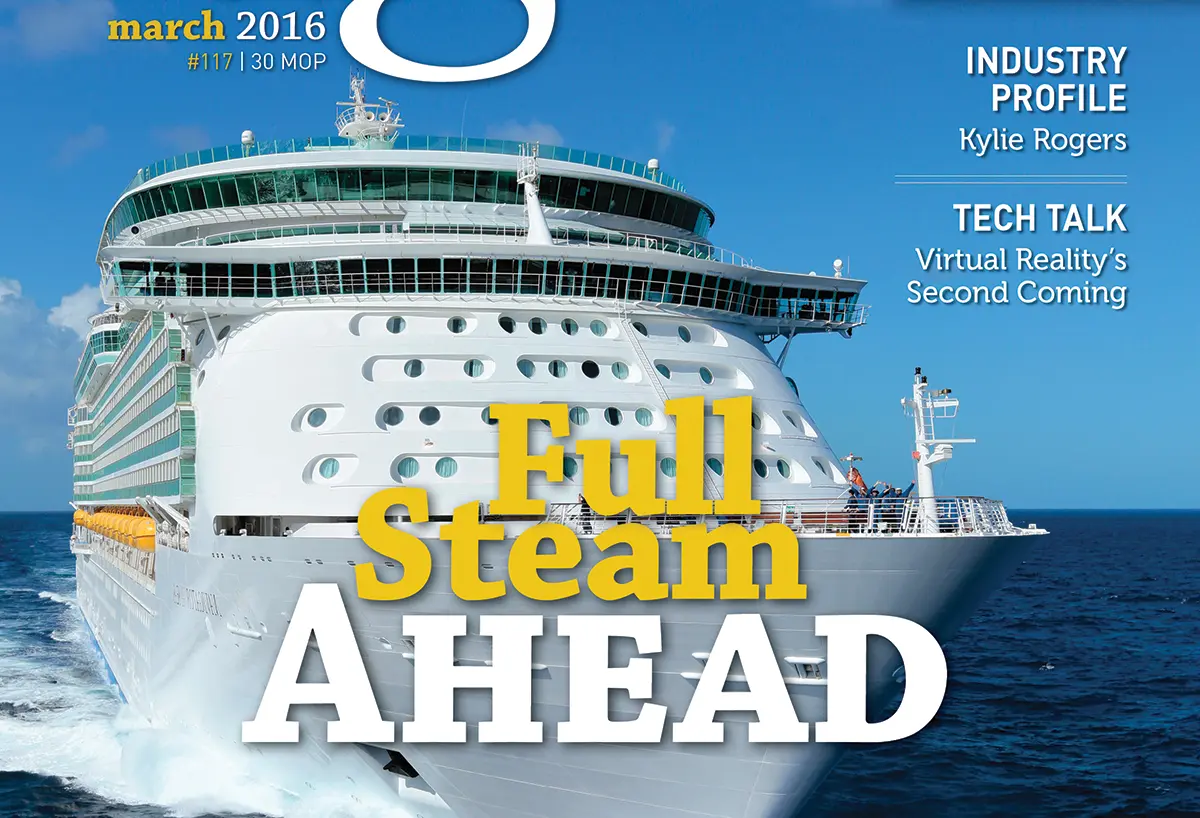

In this regular feature in IAG to celebrate 20 years covering the Asian gaming and leisure industry, we look back at our cover story from exactly 10 years ago, “Full steam ahead”, to rediscover what was making the news in March 2016!
The global cruise ship industry was sailing on smooth waters prior to the COVID pandemic and is surging again – bolstered by a renewed zest for travel and unique experiences.
And while Asia has taken a little longer than the rest of the world to claw its way back – likely due to the later reopening of China than most other jurisdictions – the signs remain positive. From a threefold increase in cruise passengers in 2023 to 2.4 million, Asia-wide passenger numbers rose 13% to 2.6 million in 2024, with industry forecasts suggesting a hefty jump to as high as 3.8 million in 2025. Cruise revenue is estimated at around US$2.7 billion for the year.
Globally, the rebound has been even stronger with 31.7 million passengers reported in 2023 – already 7% higher than in 2019 – rising to 34.6 million in 2024 and forecasts of 37.7 million in 2025. Revenues reached US$30.1 billion as of FY24.
 Of course, for those cruise ships that also offer gaming as part of their sailing experience, casinos have played their part: “onboard” revenues – comprising gaming as well as other services like alcohol and retail – typically generate anywhere from 20% to 35% of all revenue for most cruise ship operators.
It is estimated that cruises generated around US$8.2 billion globally from gaming in 2024, with that figure forecast to rise to US$15.5 billion by 2033 according to market research firm Dataintelo.
IAG explored the economics of the cruise ship sector in March 2016, and while the industry has undergone significant upheaval since then – just look at the COVID-induced collapse of Genting Hong Kong – there are comparisons that remain relevant today.
One is the nature of the cruise ship passenger. Described as a niche offering serving specific types of players, cruise ship casinos have never been seen as posing any real threat to land-based jurisdictions like Macau or Singapore.
“It’s a particular market segment that will get on board, sail out, punt all night and into the early morning hours, and then get off around noon and head straight into the office. It’s not for the faint hearted!” explained Global Market Advisors’ Asia head Shaun McCamley at the time. “Moreover, there’s no opportunity to try your luck at a different casino, and other amenities are limited. Bottom line, the cruise business has never been felt to be a threat to land based casinos, and even with the turmoil today, I don’t see that ever changing.”
 Likewise, for many cruise patrons, gaming is seen as just one of the many entertainment options onboard, and with most genuine VIP players typically preferring to stay land-side, cruise ship casinos are known to offer smaller betting limits designed for an afternoon or evening of light entertainment.
However, that doesn’t mean that cruise ships don’t offer their own incentives for players and in many cases – historically at least – better junket commissions than those available elsewhere because of the absence of gaming taxes.
As IAG wrote back in 2016, “Gaming cruise operators generally run their businesses much like other casinos in the region. They rate players by average daily theoretical and run loyalty programs. They have VIP rooms and work with junket agents, most doubling as subagents in Macau. Ships include pawn shops.”
We also noted that cruise ship casinos offer convenience for those who may not want to endure the rigmarole associated with other gaming options.
“Passengers board, perhaps have a quick meal or nap in their cabin and within minutes of casting off, they can start playing. No hassles with ferries, Macau immigration or shuttle buses,” IAG wrote.
 “Singapore residents avoid the SG$100 (US$70) entry tax at the city’s integrated resort casinos [and] for rated players, cruises are generally free. Minimum bets are lower than those at Macau or Singapore tables. On the VIP side, commissions can reach 1.60% of rolling, compared with 1.25% in Macau. Credit to junket promoters can run up to HK$50 million (US$6.4 million) per cruise.”
Those conditions may have shifted, but for Asia’s cruise ship operators the opportunity that exists in 2026 is not so different from the possibilities of a decade ago.
“The goal is to cater to China’s burgeoning middle class,” we wrote in 2016.
 “Most Chinese travelers are not primarily looking for gaming, but many do want a vacation experience that includes casinos among other entertainment and leisure options. That puts Macau casino operators on a collision course with the onboard gambling offered by the international cruise operators that are steaming full speed ahead into Asia.
“The overall direction of Chinese tourism works in favor of cruises, which offer the independence and choices of an individual excursion with the comforts of a group tour, particularly for shore excursions to ‘cooler’ destinations such as South Korea and Japan where Chinese is not widely spoken.”