
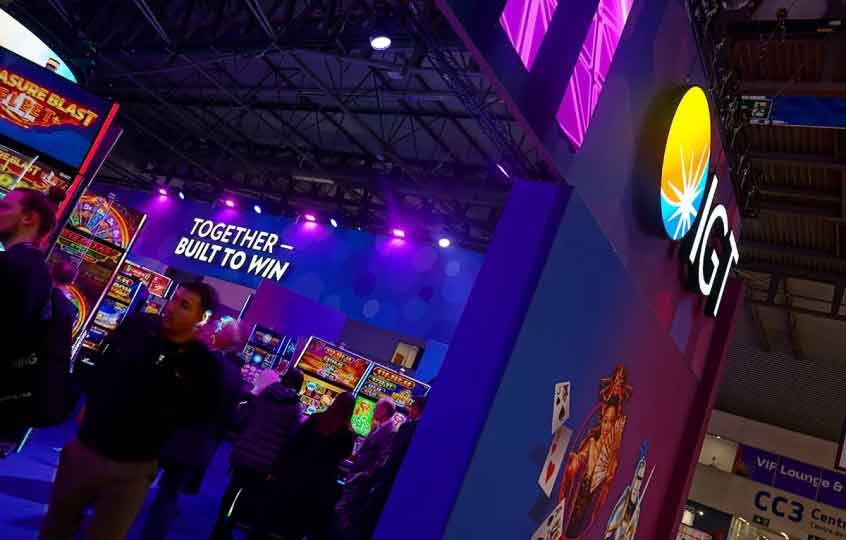

A vastly enhanced capacity for technology has been cited as a key benefit of the new-look IGT following the recent coming together of IGT’s gaming and digital businesses with FinTech firm Everi. The two entities were acquired by asset management giant Apollo in July by way of a US$6.3 billion deal.
Speaking with Inside Asian Gaming at ICE Barcelona, IGT’s Senior Director Systems Product & Sales for Asia-Pacific, John van Waard, said that bringing together the technological capabilities of the old IGT and Everi had provided new opportunities for innovation that did not exist previously.
“Now that we are looking to merge the two businesses we are evaluating all of the new technology sets that are coming along,” van Waard said.
“So, in the Advantage [system] space, the latest version of the system is a complete re-architecture that gives operators access to data in real time, brings a lot of the decision points closer to real time, for operators. We’re advancing our steps into AI with the systems as well to help with decision making and hyper-personalization of promotions for players.
“In the FinTech business, what a lot of people in Asia-Pacific may not know is we’ve now got an enterprise grade AML risk management platform as well. For markets like Australia, that’s exceptionally relevant. And in certain Asian markets we also have products that allow players to access liquidity via depositing crypto.
“There is so much technology that we now have available to us, so this process we’re going through six months on [from the merger] is all about evaluating and prioritizing what we bring to which markets.”

Van Waard added that the IGT and Everi businesses have always held natural synergies, and while there is some overlap on the tech side, this itself brings its advantages.
“Where there has been overlap, we’ve really quickly made decisions on what’s the superior technology and what are we going to use moving forward. Those were some of the easier decisions we were able make early on,” he said.
“And now it’s all about where there is no overlap and where there are opportunities to integrate these technology sets. Which ones do we delve into first? How do we invest our time and in which markets?”
Among those markets that are a clear and obvious focus is Australia, where the expectations of regulators around core issues like responsible gaming, AML and player tracking via cashless and mandatory carded play have heightened significantly.
“One of the initiatives that has had huge visibility over the last few years is cashless and I think that’s one of the areas where we’re really well positioned to help with the entire process, from external financial institution all the way to the gaming device,” van Waard explained.
“We’ve now got all the pieces of that puzzle and we’ve participated in a couple of trials in New South Wales which were pretty successful from a technology point of view – albeit maybe not as successful from a sign-up-a-player adoption perspective for numerous reasons.
“I think the New South Wales [state] government in particular is quite invested in seeing that come to fruition. They’ve been open to working with us on what requirements should change to improve adoption.”
In Asia, IGT continues to see the Philippines as a dynamic market that welcomes the introduction of technological enhancements.
“With the success of PIGO (eGames), everyone’s looking for the omni-channel solution and ways for the player experience across all channels to be seamless,” van Waard said. “A key part of that is how players manage their funds and that’s looking like what we’re going to be world leaders in.
“The Philippines is also a good market for us to trial things in because we’ve got some great casino partners there who are willing to be at the leading edge and take some chances on technology.
“I would imagine that a lot of the things that I’ve seen for the first time here at this show [in Barcelona], the Philippines is the first place they’ll pop up in Asia.”
RelatedPosts