
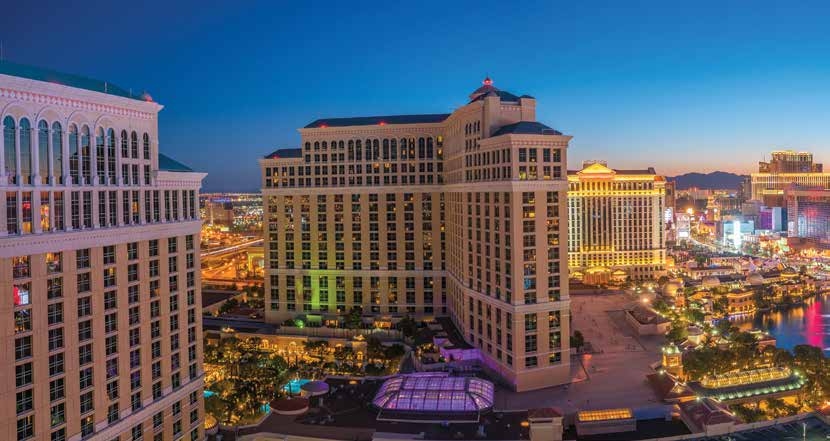

Shared social experiences, carefully crafted spaces and unique entertainment offerings have emerged as key factors in the implementation of effective non-gaming offerings in today’s integrated resorts.
“I get asked the question all the time – ‘What are the amenities I should have?’” says Tom Wucherer, Principal at world-renowned design firm and casino specialist YWS Design & Architecture.
“My answer is always the same, which is that you have to know what your market is. It comes down to what market you are catering to and what the local tastes and preferences are.” Wucherer was speaking as a panelist in a webinar hosted by The Innovation Group exploring the “Evolution of Non-Gaming Amenities” in the world’s casinos and integrated resorts – a particularly relevant topic for the industry right now given the rapidly changing customer demographics that are forcing operators to increasingly think outside the square.
Evolution within the gaming industry, of course, is nothing new. As Wucherer notes, “The only constant in gaming is change.” But the nature of that change is also evolving.
“Like the evolution of any product as it becomes more competitive and more mature, we started with some of the simple things – adding more food offerings, adding more entertainment offerings and it just keeps adding,” he continues. “It’s no different from an automobile where, although it is basically the same as it was in the 1950s, you can certainly notice the difference between a car today versus a car back then.
“The casino industry did the same thing – they are much more sophisticated spaces now, we have a much deeper understanding of how people interact with those spaces and what other things we can add onto them.”
As it stands, the industry is in the midst of a seismic shift that experts believe will continue to shape the nature of casino and amenity design for years to come. And it is all centered around one word – “social.” Be it social media or social space, the customers of today demand experiences they can enjoy with friends and share with the world.
“I think [casino amenities] have to be social,” explains Joe Scibetta, Vice President of Development and Operations at Rush Street Gaming.
“The regular sit down restaurant with the white table cloth, that’s going to need to be there in some capacity but will need to be coupled with a social environment. People want an environment with communal tables.
“Of course you need to cater to the VIP who wants to be left alone but the trend will be that amenities have to be high energy, social and be able to attract all these different socioeconomic groups. That’s a tough challenge but it’s what it has to be.”
Scibetti points to the advent of social media as having played a significant role in this evolution and although getting it right is tricky, the payoff for creating a space that stands out from the crowd is potentially huge.
“One of the key goals is to create something that is cool enough to get onto social media so we then get followed via [social media] word of mouth,” he says.
“Social media has really taken over how people speak to each other and how we interact. To be able to walk into a space with your friends and family and try different things is a big thing now.
“The days of the food court where you have one focal point sharing different kitchens is gone. You have to get very creative. “The other big change is that when you put a new food offering out there, it really has to be good. Atmosphere just won’t cut it anymore. To have a cool design of a restaurant is fantastic and people will talk about it but you really need to have very good food and that’s a change. That’s a trend.
“You just can’t throw a regular menu at them without thinking about what you’re putting out there and how it is presented. It’s about good food and sharable food which really fits into this environment of a social atmosphere with friends. It’s been happening for two or three years now and this is how the world interacts with each other today.”
In a similar vein, operators in major markets such as Macau and Las Vegas are moving away from spaces designed specifically for a single purpose and looking instead for opportunities to combine a wider range of experiences.
A prime example is MGM Grand’s Top Golf complex on the Las Vegas Strip.
Described by MGM as “a four-level entertainment venue,” it features not only high-tech hitting bays for those who enjoy the occasional swing but also multiple bars, swimming pools, meetings spaces, quality food offerings, a stage for live performances and VIP cabanas.
“Top Golf in itself is an experience venue but the Las Vegas one is that on steroids,” says Wucherer, whose company designed the project. “They added in a food component, they could add in a gambling component too if they wanted and that’s really where the trend is heading. We’re doing an eSports arena at the moment that will not just be an eSports facility, it will be a whole experience in itself and the goal is to capture those social moments so that your customers are really generating your buzz for you.”
“One of our clients calls them hero moments, that selfie the customer has to have. You go all the way back to the Bellagio fountains – it’s hard to find someone even in China that doesn’t recognize the Bellagio fountains and have a photo of them with the Bellagio logo on the tower behind it. It’s a wonderful social mechanism and that happened to be a happy accident if you will because social media wasn’t even around when we designed that place.
“But that’s what people want – they want to be able to go into the facility, to have an experience, they want it in a smaller environment and they want to be able to talk about it.”
It’s the sort of social media mechanism that has helped the Venetian Macao – renowned as the largest integrated resort in the world – become one of Macau’s must-see attractions or the replica Eiffel Tower at neighboring Parisian Macao become a favorite photo spot for tourists.
But, in time, it is likely that this new use of space won’t be restricted simply to an integrated resort’s non-gaming amenities. With customer demographics rapidly changing and customers looking for a different type of experience from their entertainment spend, it is inevitable that casino gaming floors will also soon feel the squeeze.
“The one big question over time is what happens to the negative space where we have always put slot machines?” askes Wucherer. “Traditional casino design has a large gaming floor that has a bunch of amenities around the perimeter and it’s really the negative space that creates the casino floor.
“I think part of where the younger generation gets intimidated is by those big, open spaces that we have to start making a little bit more cosy and friendly from their perspective so that they’re not just out there in the middle of a 90,000 square foot or even a 50,000 square foot negative space. Rather than negative space, it will need to be a designed, specifically built environment. “That’s where this is going to go.”