

Macau casino licensees SJM and Galaxy offer revenue sharing arrangements to joint venture partners and VIP room operators. Octo Chang looks at the different arrangements on offer, and the likely changes in the pipeline.
Stanley Ho’s Sociedade de Jogos de Macau (SJM) – under its previous incarnation STDM – pioneered the revenue sharing model in Macau. It was a model that took into account the intrinsic propensity in the Chinese culture to build relationships in order to achieve “group identity” as opposed to the celebration of individualism in Western culture. In fact, you will most often hear the phrase “Let’s profit together” or variations thereof, upon the closure of deals in the region. The SJM model of splitting revenues between the casino licensee and owner of the casino property and VIP room operators was termed “revenue sharing”, a nomenclature that has been picked up by some of STDM’s former wards, including PAGCOR in the Philippines.
JV property owners
Under the SJM system, revenue is shared in the so-called 40:40:20 proportions: 40% of gross revenue (or thereabouts) goes to the Macau government as tax, 40% to the owner (i.e. the landlord that provides the casino space, such as the owners of the Holiday Inn, Grand Emperor and Mandarin hotels) and 20% to SJM.
The Macau government is the biggest winner of course. For its 40%, it merely has to assign a few inspectors to the property. The owner for its share has to provide the building (increasingly expensive), utilities, SJM staff meals and everything else that is not part of the gaming operations: F&B, customer relations, VIP services and marketing, etc. SJM provides all the gaming equipment, consumables, staff and management, surveillance and security and even casino housekeeping.
SJM had a sweet deal in the old regime, when dealers were paid 5,000-6,000 patacas per month. Staffing costs then were probably only around 7-8% of gross revenue (GR), with other overheads adding up to maybe 13- 14% of GR, leaving SJM with a net of around 6-7% clear profit.
Competition has brought rapidly rising costs, and SJM’s labour costs alone now probably account for 15-17% of GR. As for why some of the newer casino operators do not have such costs, the answer is in the average take per table. Whilst the new operators may have higher variable costs per table, their overheads although also higher are spread over a much bigger number of tables, thus potentially giving them lower fixed costs per table. And with their higher revenue per table, their staff cost per table thus end up paradoxically being lower as a percentage of GR.
SJM is trying to control its costs by assigning fewer staff to its joint venture (JV) owners, resulting in fewer tables being opened and in turn driving down revenue; a classic accounting driven downward spiral.
Enter Galaxy, whose business model is similar to that of SJM. Galaxy too has JVs where Galaxy manages the gaming operations on behalf of the owners of the so-called Galaxy city clubs (Waldo, Rio, President and Grand Waldo).
Where Galaxy and SJM differ is in the share going to the property owners. The government’s share is constant at 40%, leaving 60% for the JV owners and Galaxy to share. As opposed to the flat 40:20 split between the owners and SJM, Galaxy has a 2-tier system according to sources within the ranks of the city clubs’ shareholders.
From its main hall business, Galaxy takes 7-9% in “management royalties,” leaving the owners about 51-53% of GR. On the VIP room side, they take about 11-13%, with the VIP room operator getting 47-49%. Galaxy does this by passing on all the costs borne by the casino licensee under the SJM model to its joint venture owners.
This discrepancy may help explain why Galaxy city clubs are still going strong on the VIP-junket business, but are languishing on the grind business.
Under the Galaxy regime, the VIP room operators now get say 48% compared to 40% under SJM’s system, however they have minimal costs in terms of the gaming staff (depending on the allocation regime); certainly the increase in margin exceeds the incremental costs. They are thus – as pointed out in my previous article, A Junket Primer – more able to compete and survive in this increasingly competitive market than their counterparts operating under the SJM system.
The main floor business is another story. With the Galaxy JV owners getting only 11- 13% more in GR but having to bear all the costs that SJM absorbed (in fact their costs are probably higher as Galaxy employs more expatriates and has higher staffing ratios per table), their resulting net share of GR is probably around only 31-33%. Galaxy would argue that their casinos are better managed and more productive, and that may well be the case, but the city club owners are still caught in a squeeze between the large-economies-of- scale operators and the slightly more profitable SJM JV properties. Recent changes in shareholdings at Waldo and President could be seen as evidence of this predicament.
Getting back to the SJM, having realized that his once cosy and quite profitable arrangement is now facing severe bottom line pressures, Stanley Ho has taken a new tack by offering a new revenue sharing arrangement with his JV owners. SJM has been negotiating with its JV owners for the last nine months on a new deal which is similar to that of the city clubs with the following exceptions:
a. SJM will keep only 5% in “franchise fees” and will cede 15% GR as well as casino management control back to the JV owners on the main hall business, in return for the owners accepting all costs.
b. SJM will, however, maintain the full 20% on the VIP business.
Obviously, apart from SJM now having a nice little guaranteed net revenue share, this means the SJM JV owners will get a much bigger share, and although the costs they are accepting will initially be higher than the percentage GR share, they are quite willing to do so as they will gain a much higher degree of casino management control as well as the ability to compete more effectively.
David Chow, with his Pharaoh’s casino and the new Babylon, was the first to accept this new arrangement. The other JV owners are currently awaiting their turn, with deals accepted to be reached quickly now that SJM has got the Grand Lisboa opening out of its hair.
On the other hand, the poor SJM VIP room operators will continue their slide towards their demise, with Stanley Ho recently prophesying that up to a third would be forced to shut because of Macau’s junket commission war (with commission rates having risen to a level where there is barely any margin left to cover overheads).
In turn, following the SJM revision, Galaxy’s JV owners will now press Galaxy to offer them more favourable revenue sharing arrangements.
You have to ask: why bother paying US$900m for a sub-license – as Melco PBL did last year to Wynn Macau – when you can pay as you go and at only 5%? After all, you would need to make around three times the total gaming revenue for the whole of Macau in 2006, not factoring in interest and opportunity costs, to justify the up-front lump sum license fee.
VIP room arrangements
Now, to go further and look at the arrangements between the casino licensees and VIP room operators, who effectively run mini-casinos.
The VIP room operator sub-leases a space in a casino, puts in the refurbishment and has SJM or Galaxy run the gaming operations. This entitles the VIP room operator to either 40% (at SJM) or 48% (on average, at Galaxy) of the revenues. They in turn have three choices:
1. pay either junket commission, or
2. sub-lease individual tables out; or
3. negotiate their own profit share arrangement; with their junket or sub-junket operators.
In fact, a VIP room may have all three separate arrangements or combinations and permutations thereof co-existing in the one room simultaneously.
Say, for example, Happy Go Lucky VIP Room has three tables (seems to be the standard number). HGLucky wants a spread of risks and therefore subleases Table 1 to Junket A for a fixed sum every month. This gives him a guaranteed income every month with which to cover part of his overheads. Table 2 may then be designated as his shared risk, i.e. he will go 50:50 with Junket B and share in the wins/losses and possibly commission payout. Lastly, Table 3 will be HGL’s own table, i.e. HGL assumes the full risk for that table and pays only commission to Junket C. In actual fact, Junket B and C can move freely between Table 2 and 3, as the means of identifying their respective customers and play is through the use of separate sets of junket chips.
Some of you may at this stage ask why Junket A would sublease just one table. It may be that Junket A has insufficient customers to justify a whole room, or he may simply not want to carry such a big overhead. Or he could be one of those persons deemed unsuitable to hold an official junket/VIP license.
This use of junkets and sub-junkets is also one of the reasons why the junket/VIP room business is becoming increasingly marginal. Where each VIP room in the Lisboa may have say 3-4 junket operators working the room, and in turn each of them may have 3-4 sub-junkets under them in the old days, most of the junkets have gone out and started their own VIP rooms at Galaxy’s Waldo during Macau’s first post-liberalisation gaming Big Bang. With the proliferation of casino properties and the VIP rooms, almost every junket as well as sub-junket operator now runs its own VIP rooms, with the resultant dilution of business over a greatly expanded number of rooms.
On a separate note, the Grand Lisboa has finally opened, whereas it was announced recently that the opening of Melco PBL’s long awaited Crown Macau will be delayed yet again from April to May.
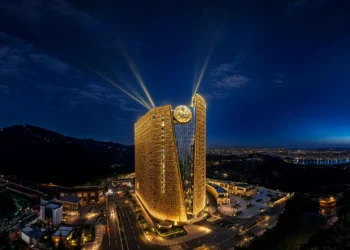
Although some would argue the Grand Lisboa is a cheaper copy of Sands, with heaps of feng shui elements thrown in (witness the giant purple egg in the middle of the first floor gaming area), the Grand Lisboa has two noticeable design features that could very well work in its favour. Forget the garish neon beloved by some and bemoaned by many. That active domed display together with the little outdoor area has the potential to turn that front courtyard into Macau’s de facto town square for punters and visitors alike. If Frank McFadden’s mob could only move quickly enough to entrench that as a tourist attraction, that would be a major battle won in this increasingly cluttered marketing environment.
Octo Chang is the pseudonym of our regular columnist, a Macau-based casino marketing professional with an extensive background in the gaming industry throughout Asia and Australia. Please feel free to forward any amusing anecdotes or observations to ka.chng@gmail.com.
RelatedPosts