

The Laos government appears to have adopted a decidedly unfavorable stance toward its casino industry, reports Indochina correspondent Rich Meyer
Laos was on its way to becoming the next Cambodia, even possibly besting its neighbor. Until a few months ago, it had three major casinos with sizable hotels, one near China and two near
Thailand, and it had a number of border slot venues and minor gaming sites. It was a virtual carbon copy of the Cambodia hub-and spoke model: a strong monopoly complemented by a wide range of other operations. Politics didn’t hurt. For a time, when Thailand and Cambodia were fighting a small undeclared war at the Preah Vihear temple between 2008 and 2011, Thai retail traffic started to head toward Laos rather than Cambodia so as not to show support for the enemy and to avoid danger.
The main casino in Laos has been the Savan Vegas. It is situated on the Mekong River across the second Thai-Lao Friendship Bridge in Savannakhet, a border town about an hour flight from Bangkok. The operation, officially opened in 2009, has about 85 tables, over 500 electronic gaming machines and four VIP rooms. The main floor is 40,000 square feet in size, and the hotel has over 500 rooms.
The other main gaming site in Laos was until recently at Golden City, Boten, in a 1,640-hectare special economic zone on the border with Yunnan Province, China. In 2007, the Royal Jinlun Hotel opened at Boten and at one point had an estimated 150 tables and 300 machines. Laos also has the King’s Roman casino, set in a 10,000-hectare special economic zone on the Thai border, and the Dansavanh Nam Ngum Resort, north of the capital city of Vientiane.
But despite the good start, Laos will probably not, for the time being at least, be another Cambodia. In the span of a few short months, most of the casinos have been closed, sued or had their foreign partners kicked out. First, in the spring, the government unceremoniously shut down gaming operations in Boten after an incident last December in which Chinese gamblers were allegedly held hostage for unpaid debts. The area is now being developed as a commercial and cultural center and being downgraded to a “specific economic zone” from a special economic zone. Then, the Thanaleng Slot Club, at the first Friendship Bridge, which links Thailand and Laos at Vientiane Prefecture, was forcibly taken from Macau’s Sanum Investments by ST Group, the local partner in the club. Vientiane Commercial Court also ordered Sanum to pay ST US$5 million in damages as a result of the dispute.
That was followed by Savan Vegas being presented with a surprise $23 million tax bill by the Lao Tax Department; Seizure of the property was imminent at press time. According to Jody Jordahl, the president of Sanum Investments, the foreign investor in Savan Vegas, the government is asking for three different taxes to be paid: a construction tax, a fee for overtime at the border crossings and a tax on junket operators. He says that all the claims are without merit and that the taxes don’t have to be paid either because specific agreements with the government exempt the casino—as with the construction tax—or because the tax is not due under Lao law.
“They are charging retroactive taxes that are incorrect based on our agreements,” Mr Jordahl says, adding that some of the taxes are also incorrect “based on an easy reading of the tax law.”
Sanum has asked for international arbitration by the International Centre for Settlement of Investment Disputes, a World Bank entity. Mr Jordahl believes that Laos is compelled to comply because of the bilateral investment protection treaties it has signed with the Netherlands and China. Lao Holdings, a Dutch company, is Sanum’s parent, and Sanum itself is a Macau company, allowing it to seek protection under China-Lao treaties.
According to Mr Jordahl, the judgment against Sanum was forced by the government and the verdict reached even before the case was heard. The ST Group, a Lao diversified conglomerate founded in 1994, is a well-connected company, he claims, and probably has the power to force interference in the judicial process.
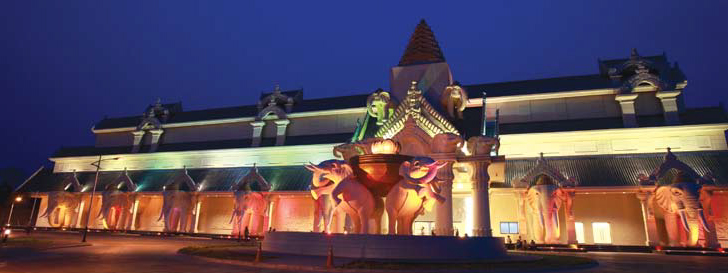
Presented a mammoth tax bill—Savan Vegas Hotel & Entertainment Complex
“It was clear that it was a complete sham in the court,” says Mr Jordahl.
The Thanaleng Slot Club takeover may simply have been a matter of greed, he says. The property was starting to make a significant sum of money, netting US$2 million – $3 million a month, and the contract was about to change. Sanum was about to become 60% owner and ST 40%; the split had been ST 60% and Sanum 40%. He adds that the Savan Vegas tax assessment may have something to do with the original agreement between the government and Sanum. The casino has a 50-year monopoly in three provinces—Savannakhet, Bolikhamxay, and Khammouan—and Jordahl speculates that the government thought it would be better to put Savan Vegas out of business, end the monopoly and issue more licenses.
Mr Jordahl believes that Laos is shooting itself in the foot. Sanum claims to have invested US$85 million in the country and to be the fifth largest employer there. The business created is now in jeopardy. And if the country is found not to have respected the rule of law and its international obligations, future investments could be threatened. He adds that many people in Laos agree with Sanum. They understand that the reputation of the country could be damaged if it is found that the cases were in fact decided as a result of government interference and pressure from ST. Mr Jordahl says that the judges had no choice, as they would have been replaced if they had reached the wrong conclusion in the case. Others are afraid to say anything because of possible repercussions.
“Nobody wants to put their hand up,” says Mr Jordahl, “for fear of getting it chopped off.”
According to Mr Jordahl, the government has been ignoring Sanum and not willing to open dialogue. But he also notes that it may be now starting to take notice. As of early October, Savan Vegas was still in operation and Sanum’s other two slot clubs, one on the Vietnam border at Lao Bao and the other at the Savannakhet Ferry Terminal, are still up and running. Mr Jordahl believes that all the pressure might be having an effect. The case has received quite a bit of publicity, and it will get more if it goes to arbitration. The international interest probably hasn’t gone unnoticed in the government.
“They are concerned that we have brought attention to it,” he says.
That could be the company’s main strategy, and an effective one. Sanum is making a lot of noise, and that may be enough. It has hired Hill+Knowlton, a first-rate international PR firm, to handle corporate communications. It has also set up a website—shameonlaos. com—to get its complaint more exposure. With the Asean Economic Community set to be formally established in 2015, the whole region will be sensitive to shabby treatment of foreign investors.
Furthermore, Laos gets a lot of support from the West, and the brazen expropriation of foreign assets may not play well with the donor community. It would be especially offensive and ill-timed now, as Laos is scheduled to be accepted into the World Trade Organization this month.
Mr Jordahl remains concerned though. The casino is still in operation, but he worries that the government may be simply delaying the inevitable for tactical reasons. Laos might just wait until after the 9th Asia-Europe Meeting Summit of Heads of State and Government (ASEM9), scheduled to be held in early November in the capital, Vientiane, before actually taking possession of the casino, finishing the job once the foreign observers are gone.
RelatedPosts