
Long established as the definitive list of the most influential figures and personalities in the regional industry, IAG’s Asian Gaming Power 50 celebrates its 19th anniversary in 2026.
It is now 18 years since Inside Asian Gaming first published the Asian Gaming Power 50, and it’s hard to believe just how far it has come as we arrive at our 19th Power 50 edition. Once a fun idea aimed at generating some interest, it has now become our most hotly anticipated publication of the year and with its very own glamorous black-tie dinner.
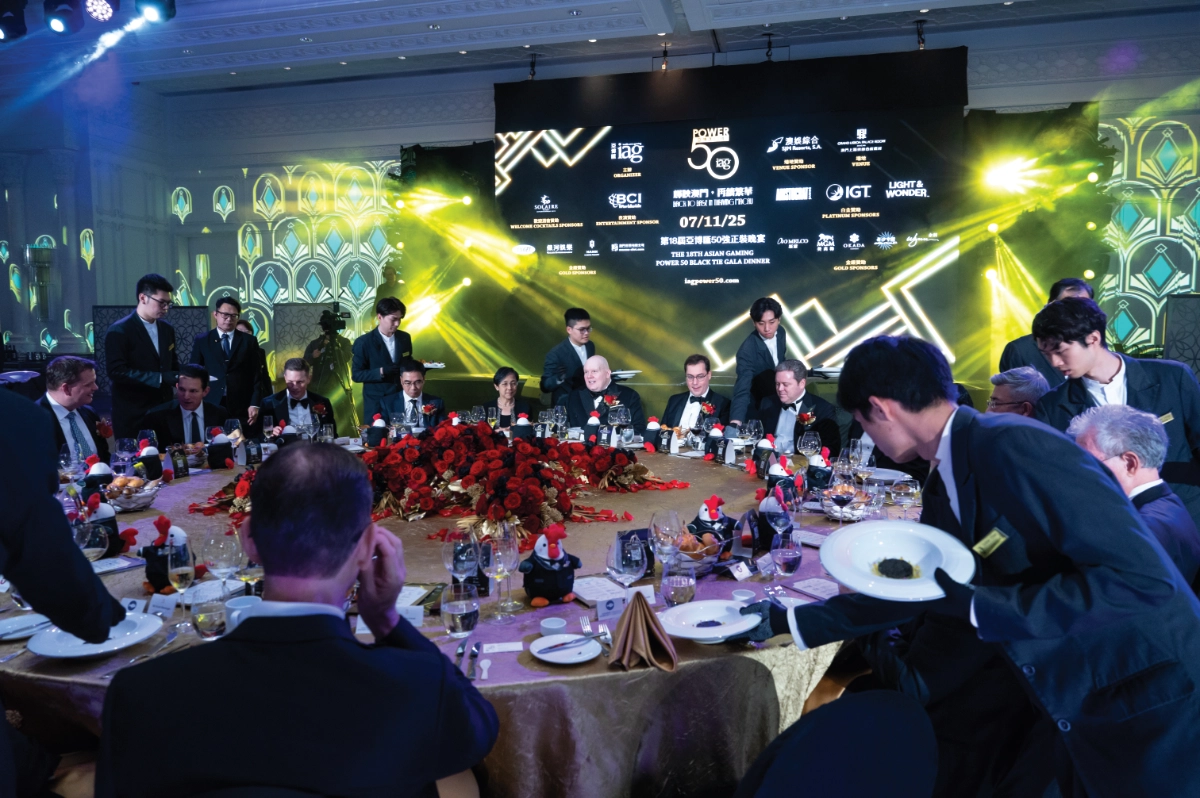
The Power 50 Black Tie Gala Dinner rotates on a six-year cycle amongst the six Macau concessionaires and this year is being celebrated at the Grand Ballroom at the JW Marriott hotel at Galaxy Resort.

The Power 50 list covers the entire IAG APAC coverage region, from the Middle East to the International Date Line. The Power 50 began as a fun and innovative look at those who make our industry tick, but it has now evolved into an important annual insight anxiously awaited by all. Compiling the Asian Gaming Power 50 list is an intriguing, demanding, educational and exhausting task, yet one that comes with enormous responsibility, as the Power 50 has become the undisputed and definitive guide to the “big end of town.”
Ranking the big boys (and girls) from 1 to 50 is a difficult challenge at the best of times, but one made even more difficult given the upheaval our industry endured during and since the pandemic. That impact, however, has now well and truly subsided, and it has been terrific to see Macau soaring again alongside the impressive year enjoyed by operators in Singapore. The Philippines and Australia have faced their challenges, but I have no doubt they will rebound in due course.
Some of the biggest stories of the year relevant to the Power 50 have included the stabilization of Macau GGR to around US$2.5 billion per month, the runaway train that is Marina Bay Sands in Singapore, the intriguing stories unfolding in Australia and the Philippines, and the looming emergence of Wynn Al Marjan Island in the UAE and MGM Osaka in Japan.

As always, with each headwind or tailwind our industry experiences, the impact on the Asian Gaming Power 50 is considerable.
HISTORY AND INDUSTRY GROWTH
The birth of the Asian Gaming Power 50 in 2008 coincided with an evolution in the region’s land-based casino industry, coming 12 months after The Venetian Macao opened its doors in 2007.
Since then, a small parcel of land measuring just seven square kilometres became the richest place on earth, now home to nine world-class integrated resorts: City of Dreams, Galaxy Resort, Grand Lisboa Palace, MGM Cotai, Studio City, The Londoner Macao, The Parisian Macao, The Venetian Macao and Wynn Palace.

This hugely successful Cotai integrated resort model spread like wildfire across the APAC region. The Philippines has been a fast-growing market, with its four Manila IRs – City of Dreams Manila, Okada Manila, Newport World Resorts and Solaire Resort Entertainment City – along with Hann Casino Resort in Clark and NUSTAR in Cebu, making it a clear number 2 on the Asian gaming scene.
In Singapore, Resorts World Sentosa and Marina Bay Sands are now world-renowned landmarks, and MBS is often referred to as the most profitable IR in the world.
In Cambodia, NagaWorld enjoys an effective monopoly, disregarding the multitude of small properties on the Thai and Vietnamese borders.
Paradise City, INSPIRE, Jeju Shinhwa World and Jeju Dream Tower have introduced the integrated resort concept to Korea, although Kangwon Land remains the only casino in the country where locals are permitted to gamble.

Meanwhile, Vietnam is home to Corona Resort & Casino, The Grand Ho Tram and Hoiana.
Despite such incredible development across the APAC region, only four people have sat atop the Asian Gaming Power 50 over the past 18 years. They are Dr Stanley Ho, Lim Kok Thay, Sheldon Adelson and Francis Lui.
CHANGE IS PERENNIAL
The Power 50 list is not a place for people to rest on their laurels. While company longevity and/or executive tenure is a small factor, the list predominantly focuses on the activities of the prior 12 months. It’s all about “what are you doing now?” and “what have you done lately?” not “what have you done in the last 17 years?” As such the Power 50 list is very dynamic as people move up, and down, and on, for a multitude of reasons. A persistent phenomenon during the making of the list each year is the “My business has grown therefore I should move up the list” fallacy. The truth is everyone lifts in a rising tide. Most people on the list are managing businesses that grow each year, and just to maintain a spot on the list requires annual growth. Someone doing the same thing year after year and achieving zero-growth results will slowly slip down the list as the years roll by.
HOW DOES THE JUDGING PANEL DETERMINE THE RANKINGS?
We have been asked this over and over across the years – and continue to be asked. Despite the fact we’ve explained it many times – let’s explain yet again!
Even though the judging panel has become quite adept at putting this list together over the years, the task of ranking industry leaders seems to get more complex as the Asian gaming industry continues to mature and becomes more nuanced.
 How on earth does one compare the sole owner of a smaller property to the brand new “hired help” COO of a much larger one? How about comparing a large property that is still in pre-opening to a smaller one that has been active for years? The CEO of the Hong Kong Jockey Club versus the head of a private casino company versus the President of a casino chain in Korea that doesn’t have locals gaming? And how should online and offline gaming be compared? Or more complex still, how should the judges assess a company with both land-based and online gaming? These are the types of tough questions the selection panel of the Asian Gaming Power 50 wrestles with every year.
As with any such ranked list, there are always criticisms and objections, usually from those who feel slighted. We often hear claims of not reading the list or not caring about it, but we are often sent messages, sometimes directly but more often through surrogates, bemoaning the injustice of a perceived lowly position and lobbying for the following year. Some lobby us to not be on the list as they feel it raises their profile too much. But no one ever contacts us to complain about being ranked too high!
 The rankings include a numerical “Power Score” for each person on the list.
The calculation of this score is a mix of science and art. Points arise from a number of factors including the GGR and Adjusted EBITDA of the person’s organization, a weighted dissection of those points between the top senior executives with key policy control of that organization, adjustments for whether the person is hired or has a major equity position, their length of tenure, how active in business initiatives the person has been in the prior 12 months, the long-term gaming pedigree of the person, the jurisdiction in which he or she operates and many more. Some factors are necessarily subjective, but we’ve always assigned a points value to strive for as much objectivity as possible.
We do all this without any predetermined idea of where any person should or should not be ranked.

At the end of the day, in our industry the concept of “power” generally comes down to direct or indirect control of money. The greater the GGR and EBITDA controlled, the greater the power. But it’s not all about those factors, many other factors also come into play in adjusting the final power score.
And what, exactly, is control? It’s about influence, it’s about who is the ultimate decision maker, and sometimes it’s simply about who is the person everyone in the room looks to for answers. In the same way that a country is a country because other countries say it is, some people are powerful simply because other people say they are.
Finally, I’d like to take this opportunity to thank my fellow judging panel members for their tireless work and excellent insights. And so, without any further ado, we present the 19th edition of the Asian Gaming Power 50. Enjoy!
By Andrew W Scott
Power 50 Judging Panel Chairman
For the full list of 2026 Asian Gaming Power 50 winners, click here.