
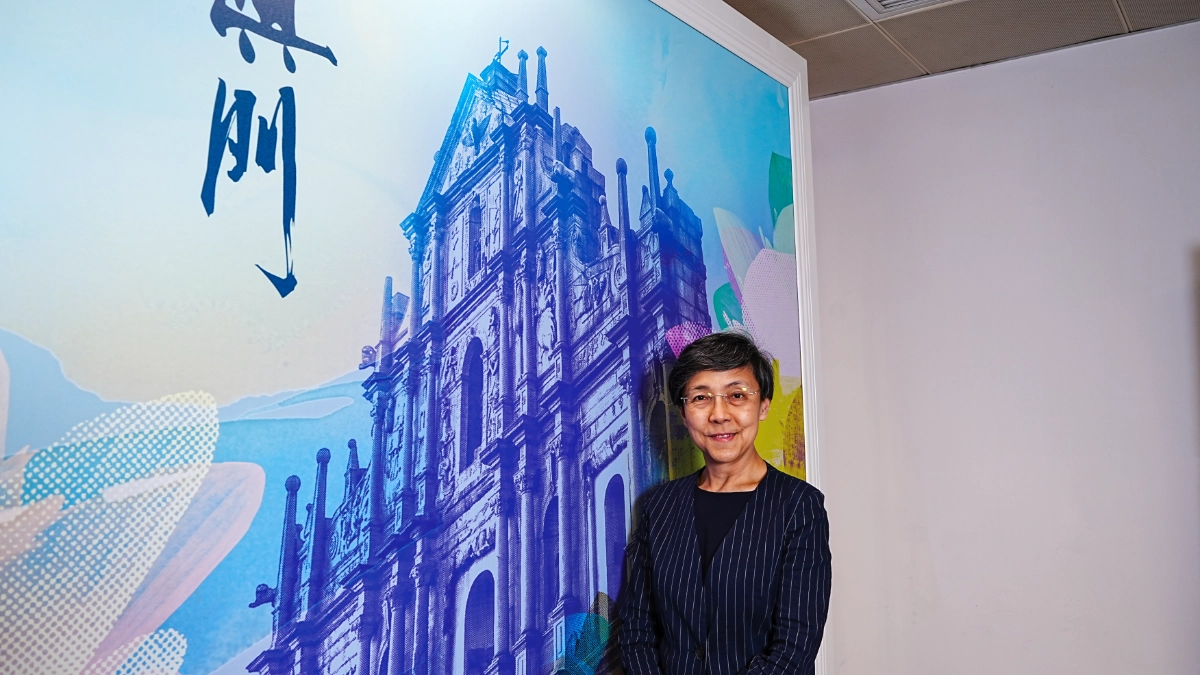

Boosting Macau’s international appeal has been a key mandate for the government, and in that regard the city’s tourism authority – the Macao Government Tourism Office (MGTO) – is swinging for the bleachers. IAG’s sister publication New Macau recently sat down for a lengthy discussion with MGTO Director Maria Helena de Senna Fernandes on the growth in international visitation and how to keep Macau relevant in a competitive regional environment. With the MGTO’s permission, IAG is pleased to explore some of the key tenets of that discussion.

Macau’s visitor wave has yet to crest, with tourists flooding in and boosting non-gaming spend by 17.4% year-on-year in 1H26 to MOP$44.47 billion (US$5.52 billion) – even as gross gaming revenue rose by just 6.8% to MOP$126.9 billion (US$15.74 billion) in the same period. But questions remain as to how high the tide can rise.
“Overall, we are expecting it to be another record year in terms of overall visitor arrivals,” notes Maria Helena de Senna Fernandes, Director of the Macao Government Tourism Office (MGTO), highlighting how Macau has been named as the most favored destination by mainland Chinese visitors in a top poll for two consecutive years. “This is a very happy moment … but going forwards, it’s also important … that the awareness campaign for the role of tourism will need to continue.”
Macau saw nearly 40.7 million visitors in 2025, up 14.7% over the previous year, with over 29 million of those coming from mainland China, up 18.5%. There were also 15.4 million mainland arrivals utilizing the Individual Visit Scheme, up by over a quarter year-on-year.

“We need that kind of encouragement to keep everybody coming,” notes Senna Fernandes. “But the other side of the coin is: will people complain that there are too many visitors again? This was a lot of the conversation before the pandemic.”
Periods such as Macau’s Golden Week holidays highlight the saturation point that Macau can reach in regard to mass visitation, with a 2019 study from the then-Institute for Tourism Studies (now Macao University of Tourism) highlighting 40 million as the city’s optimal carrying capacity annually, or roughly 110,000 tourists per day.
But the increase in concerts and sporting events – as evidenced by an absolutely packed October featuring the NBA China Games, over a dozen high-profile concerts and a handful of other sports competitions – is prolonging the high-traffic periods beyond just the holidays. This provides somewhat of a retail boost and brings some play to the gaming tables too, but it also challenges infrastructure beyond the Cotai Strip and places more pressure on the city’s lack of hotel room supply.
 Despite the packed streets, the “very, very bad three years” in which the city was mostly locked down means that angst over too many visitors has softened slightly.
“Ever since the pandemic, people have come to realize how important the tourism market is for Macau as a whole. And whilst we are right now engaging in diversification of the economy, still the reliance on tourism, on the entire integrated tourism (industry), is very, very important. There is heavy reliance still,” says Senna Fernandes.
It’s impossible to ignore how that reliance is linked to the gaming floor, with gaming spend down and expectations from J.P. Morgan that 4Q26 GGR will fall 6% year-on-year, resulting in just a 1% FY26 GGR uptick to MOP$249.1 billion (US$30.8 billion).

This is partially bottlenecked by the key count, as those wishing to stay and spend – be it at the gaming table or beyond – have limited options.
The city is still stuck with about 45,000 hotel rooms, leading to a 91% occupancy rate through August – high-end occupancy is much higher – and resulting in the 13.6% increase in day-trippers (17.85 million) seen during the same period. Overnight stays in August fell 0.6% to 11.11 million.
In response, the focus now is on quality over quantity, as evidenced by the operators’ exuberance for suites and the higher-spending gaming customers that fill them.

Target(s) acquired
One of the key markets that the MGTO and operators have been focusing on – much like the competition in the Philippines, Singapore, Vietnam and Malaysia – is Korea.
“When we started working on the Korean market, we were seeing more male dominance in terms of the visitor arrivals. Nowadays, it’s actually more female-driven. And we see family travel much more, compared to the early days when we started working on the Korean market,” notes the MGTO Director.
This fits into the wider strategy of focusing on specific demographics in nearby markets: the “low-hanging fruit.” Senna Fernandes points out that it’s “not that they are easy to catch, but at least they are easier compared to some other markets.”
 This means “Northeast Asia, Southeast Asia” as the first focus, South Korea as a lead and “the Philippines, Indonesia, Malaysia, Singapore, Thailand. These are really the markets that are, in terms of numbers, giving us more return initially,” indicates the official.
In 2025, South Korean visitation to Macau rose 11.3% to 547,638, the Philippine tourist figure was up 9.5% to 540,284, Indonesian tourism increased 13.6% to 208,043, Malaysia was up 3.9% to 188,977 and Thailand’s visitor figures surged 38.1% to 185,963. Visitation from Singapore, by contrast, declined 1.7% to 117,165.
The MGTO’s international campaigns have been incessant, with the tourism authority attending at least a dozen major international trade shows this year. And Senna Fernandes is acute in her focus on where to look for higher-spending visitors, aiming to shift from a statistical approach to visitation towards an economic one.
“When we are looking at new markets … when we look at the spending power, obviously the Middle East would come to mind,” she says, countering that the push is still in an “uncertain mode”, even as the tourism body ponders the possible “sheer numbers” of visitors it can pull from India and its encouragement of “Muslim tourism.”

But a particularly interesting focus now are the “five stans” of Central Asia: Kazakhstan, Uzbekistan, Turkmenistan, Kyrgyzstan and Tajikistan. The MGTO invited tourism industry officials from those nations “to test out the market to see their interest level in Macau,” aiming for a “gradual development” based on air traffic to regional airports – a key consideration for which markets to focus on.
Melco Resorts Chairman and CEO Lawrence Ho also visited Kazakhstan in June, meeting with the nation’s Prime Minister to discuss possible tourism opportunities, although this was seemingly more related to Kazakhstan’s push to develop its own attractions.
Lift and push
Source market expansion, be it guided by tourism bodies or the operators themselves, is always constrained by airlift, with the MGTO looking first at locations offering direct flights into Macau, then those into Hong Kong, “because these would also be the people that we might be able to quickly get across to Macau,” notes Senna Fernandes.

Macau may end up being just one stop on the agenda, given that Hong Kong, Sichuan and Chongqing are becoming increasingly sought after destinations for international travelers.
“We are seeing the possibility of more easily convincing [visitors] to do multi-destination trips, since they are looking for these products anyway,” Senna Fernandes explains. “For the other markets, probably we need to do a little bit more convincing. A lot of them don’t know how easy it is to travel within the Greater Bay Area or even into other places in China, into the mainland.”
For now, the focus is on “more education … more promotion,” working with partners – in particular travel agencies both in mainland China and abroad – and focusing on the products “so that they get interested, and then eventually they will buy these products. So, in different markets, definitely there is a little bit more convincing to do. In other markets, it’s just very natural.”
 The key is timing: “I think getting into the market early is also important. Get them to start thinking about Macau as a friendly destination that they can go to before other people come into the scene,” notes the tourism veteran.
Despite its success, Macau is still searching for the perfect tourism mixture, expanding its source markets and doubling down on its mainstays; always ready to shift to maintain its relevance as a global tourism hub for entertainment and leisure.