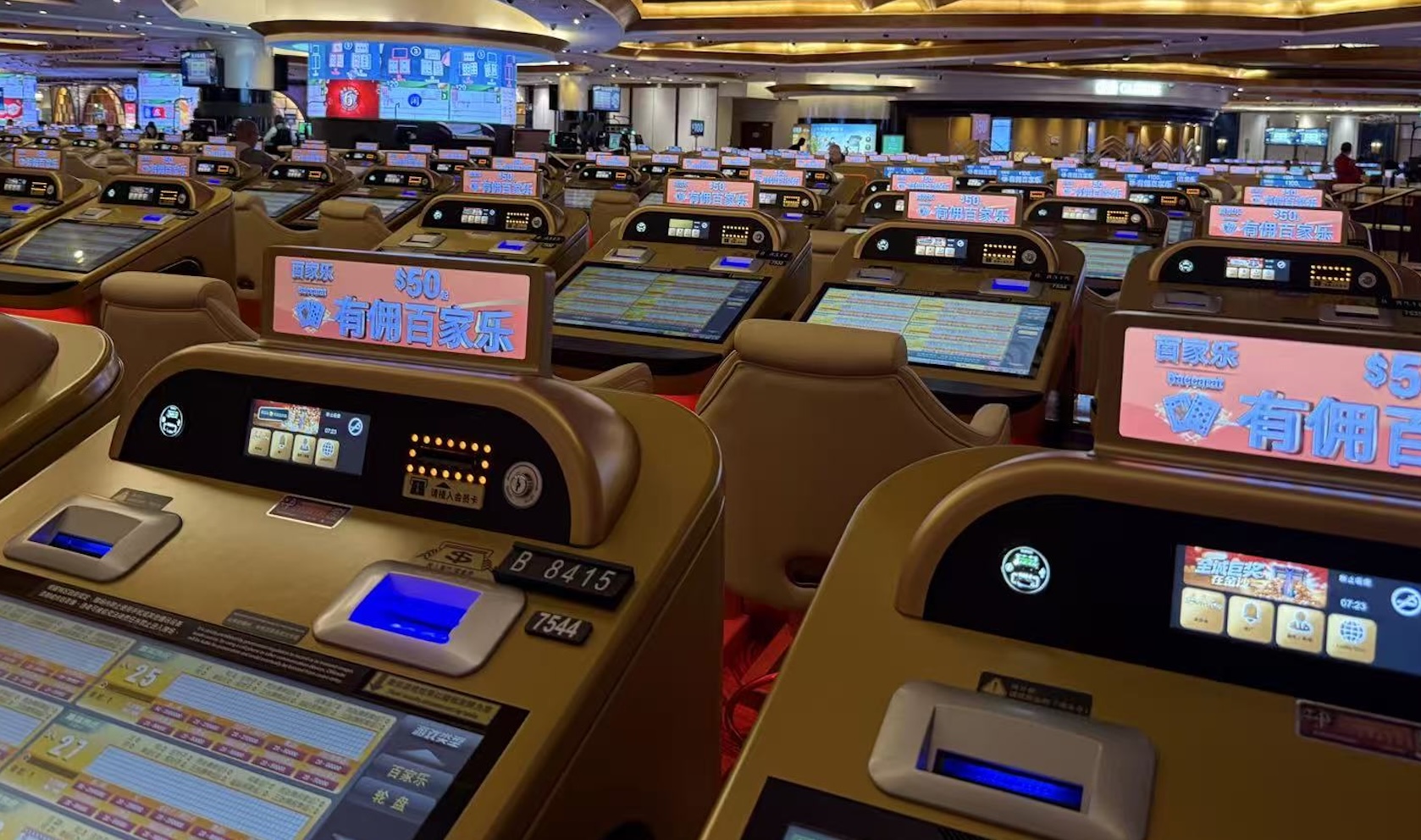

Leading industry suppliers have confirmed they are planning to launch stadium-style electronic gaming tables into the Macau market after a long-standing patent held by local manufacturer LT Game expired last week.
Patent I/380 was first registered by LT Game in October 2006 to protect the “Gaming Terminal and System” behind its Live Multi-Game terminals before expiring last week under Macau’s 20-year limit on registered patent protections. Alongside Patent I/150 on “Method and system for playing the baccarat jackpot,” I/380 has been at the heart of a near 15-year legal battle between LT Game and fellow supplier Light & Wonder over the introduction of other stadium-style products into the Macau market.
While Light & Wonder specifically, and others to a lesser extent, have long argued that their ETG products do not infringe on LT Game’s patents – a position backed by a Macau court last year – Inside Asian Gaming understands that Macau’s concessionaires have until now been reluctant to purchase those products for fear of possible legal or other ramifications.
With Patent I/380 now officially expired, those roadblocks no longer exist.
In comments to IAG, Light & Wonder’s Managing Director, Asia, Mike Smith, said, “We’ve been making a considerable investment into our ETG platform with the Obsidian product. We’ve been putting that product in front of our customers via G2E and G2E Asia for the last year-and-a-half. And regardless of the patents and LT Game strategy, we’ve been committed to developing and bringing our product to this space.
“We believe we have a very compelling and competitive and differentiated product. So, from a strategic standpoint, [the patent expiry] would have come and gone unrecognized to us because we’ve been pushing forward regardless.”
Asked if Light & Wonder had any timeline for launching Obsidian into the Macau market, Smith added, “I think what you’re going to see from us is hopefully a presence in the market in the coming year. We did achieve initial GLI and DICJ approval, but we did not move forward with achieving a deal to get inspection – and some of that probably was a result of the impending litigation or patent dispute that was out there. Some of it was also just having the right timing with the right operators.
“I do think this [patent expiry] will create market confidence to move forward, not only with Light & Wonder but potentially anybody else that wants to compete in this space.”
Spintec has also confirmed its intention to increase its Macau presence, with Chief Commercial Officer Goran Sovilj telling IAG the company welcomes the opportunity to “enrich the playing experience” for local customers. Macau’s Gaming Inspection and Coordination Bureau last year approved Spintec’s Aura, Karma and Charisma ETG products for use in the Macau market.
“We have a proven track record with our ETG (stadium) product, which has been successfully installed across Southeast Asia and other international markets,” Sovilj said. “It is popular because it consistently delivers strong performance.
“With the relevant patent in Macau now expired, we see opportunities to introduce it here as well. It is up to our established local partners to assess whether, and to what extent, this makes sense. We will also consider each opportunity in light of our long-term strategy in the region and the expectations of local operators.”
Despite the expiry of Patent I/380, LT Game said it does not expect Macau’s concessionaires to rush to market for alternative ETG products even though it is aware that testing of rival ETG options began some time ago.
“We don’t see any urgency, either internally or from our discussions with the operators,” explained the company’s Chief Operating Officer, Eddie Au.
“We all know they’ve been testing with other products and we see other products registered on the DICJ’s website, so we know who’s coming and who’s doing what. We cannot change that.
“We are just focussed on what we can do. I think we still have an advantage because we’ve been talking to [the operators] about our [LMG] product for the past 12 to 15 years.
“We know what we need to do, we know what the players and operators like and dislike and that’s the intangible that we have on our products.”
LT Game’s response is a new ETG line known as Black Coral, which the company expects to submit for DICJ approval by the end of this year. According to Au, Black Coral builds on the architecture of the company’s existing LMG product and incorporates the many enhancements developed over the past 15 years into a next-generation offering designed from the ground up.
“I think [Black Coral’s release] comes at the right time,” Au explained. “We had originally planned to release it late last year but I’m glad we didn’t push it out too early, because I don’t see the demand in the market right now – at least from our discussion with the operators.
“We have gone through a round of roadshows, we’ve talked to the operators, we demonstrated it to them, we’ve let them play with it and have collected all their feedback.
“It’s true that we might not have been as aggressive in the past as we should have been (ahead of the patent expiry) but the last few years we’ve been pushing ourselves a lot to try and come up with a better product.
“From our talks with the players and the operators, I’m pretty happy with where we are at. Of course, the ideal situation would be that we still had the patents, but I think we are happy. We know there are going to be other products in the market sooner or later but we are in a good spot.”
The expiry of LT Game’s 20-year patent comes after a Macau court last year dismissed its claims against subsidiaries of Light & Wonder over I/150 and I/380 and declared the patents null and void, ruling that the inventions underlying the patents were obvious to a professional in the field and lacked a sufficient inventive step. As such, the patents did not meet the legal requirements for protection under Macau’s Industrial Property Legal Regime (RJLP).
LT Game had launched an appeal against the decision.
The two companies have famously been embroiled in a legal battle over the patent issue for past 14 years after LT Game first launched its patent claim against Shuffle Master – a precursor to the Light & Wonder brand – in 2012. In an incident that remains part of Macau industry folklore, customs agents that year rolled into the G2E Asia trade show and covered Shuffle Master’s equipment in plastic, citing patent infringement concerns.
More than a decade on, Light & Wonder alongside Spintec, Interblock and Alfastreet are among those now preparing to introduce their stadium offerings onto Macau’s gaming floors en masse.
For Light & Wonder’s Smith, however, the fight has never been about emulating the offering of LT Game.
“Our [Obsidian] product was defined, built and established through our best practices, through our global presence of that style of product,” he said.
“We’re not in the business of going out and trying to replicate one competitor or work around one piece of one competitor. We’re really about designing a product that satisfies the global need for that style of product.
“Before I took this role I was Vice President of Global Strategy for Table Games at Light & Wonder so I’m quite familiar with the space, our roadmap and our strategy, and I can honestly tell you that we weren’t pivoting around waiting for these patents to expire or looking at what LT Game was doing or not doing. It was really around building the best global product in the ETG space.
“So, I think we’re well positioned. We do have a product that is ready to go. We’ve got a lot of interested and active customer engagements where we can go out and push to get that footprint. And I’m confident in our ability to bring that diversity and different product that the operators are seeking. I do believe we will be highly competitive with LT Game.”
RelatedPosts