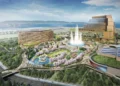

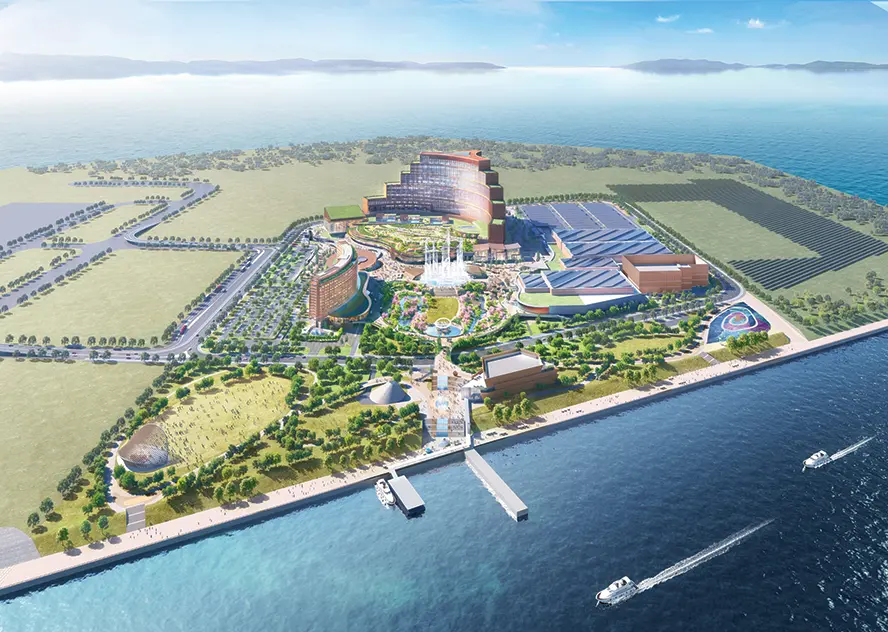

MGM Resorts will increase its annual deployment of capital into development of its Japan integrated resort project, MGM Osaka, to around US$1 billion a year in each of 2027 and 2028, the company revealed this morning.
This, it explained, will be funded from the company’s cash on-hand and free cash flow, with the remainder of the US$10 billion project to be covered by its local partner ORIX Corp and the joint venture’s yen facility with Japanese banks.
Speaking on MGM’s 3Q26 earnings call, Chief Financial Officer Jonathan Halkyard noted that the company has invested around JPY114 billion (US$722 million) into MGM Osaka so far with another JPY150 billion to JPY160 billion (US$950 million to US$1 billion) to be contributed in each of 2027 and 2028 – completing its funding commitments.
The project is substantial, with MGM confirming that MGM Osaka and possibly some share buyback opportunities would account for the vast majority of capex over the next few years.
“We are coming upon two years of investment in our Japan project at a billion dollars per year and we do that enthusiastically just because of the returns we think are associated with that project,” Halkyard said.
“As we look at the opportunities before us, it’s going to be Japan, it’s going to be repurchases and we think those are the two most important and remunerative ways to use our capital.”
Halkyard described MGM Osaka as an “over-equitized project” that would likely open at 2x leverage, adding that the company would look to refinance shortly after the scheduled 2030 launch and “potentially repatriate some funds back to ourselves and ORIX.”
Sharing is caring
While Japan looms on the horizon, MGM’s Macau subsidiary continues to fire on all cylinders after reporting record quarterly market share of 17.1% in the third quarter – aided by high hold on the gaming floor – but the performance was even better in the month of September where MGM China achieved stunning share of 19.2%.
MGM President and CEO Bill Hornbuckle said on the earnings call that those trends had continued into October, further emphasizing the company’s ascension since the pre-COVID days, when market share sat below 10%.
Hornbuckle noted that the recent opening of the newly renovated Cotai Supreme Club and Cotai high-limit slot area at MGM COTAI had resulted in longer playing times and higher playing levels from high-end customers.
Kenneth Feng, MGM China’s CEO and Executive Director, also highlighted the company’s stable margins, which reached 26.9% in Q3 and could have been higher if not for the US$22 million in intercompany branding license fee it paid to its parent company for the quarter.
“There are a lot of factors impacting our margins, like the promotional environment as well as the events calendars and high end play,” Feng explained.
“But we are focusing on our efficiency. We have guided the street on margin range at the MGM China level in the mid-to-high-20s. We have been consistently delivering this for the past few years.
“All competitors and the street are watching the reinvestment levels but like I’ve said before, the investment level or the cost level is just a percentage. It doesn’t represent [the whole story].
“At MGM China, we are competing on the underlying products, the services, the innovations. Every employee, from myself to the frontline colleagues, it’s an ecosystem. And this is kind of a positive structure that we are focusing on that utilizes our advantage and our deep understanding of our customers and our quick actions. So, to target our premium mass customers, which is what we are all competing for, it’s not purely about a figure.”
MGM China reported record quarterly revenue of HK$8.93 billion (US$1.14 billion) in the September quarter.
RelatedPosts