




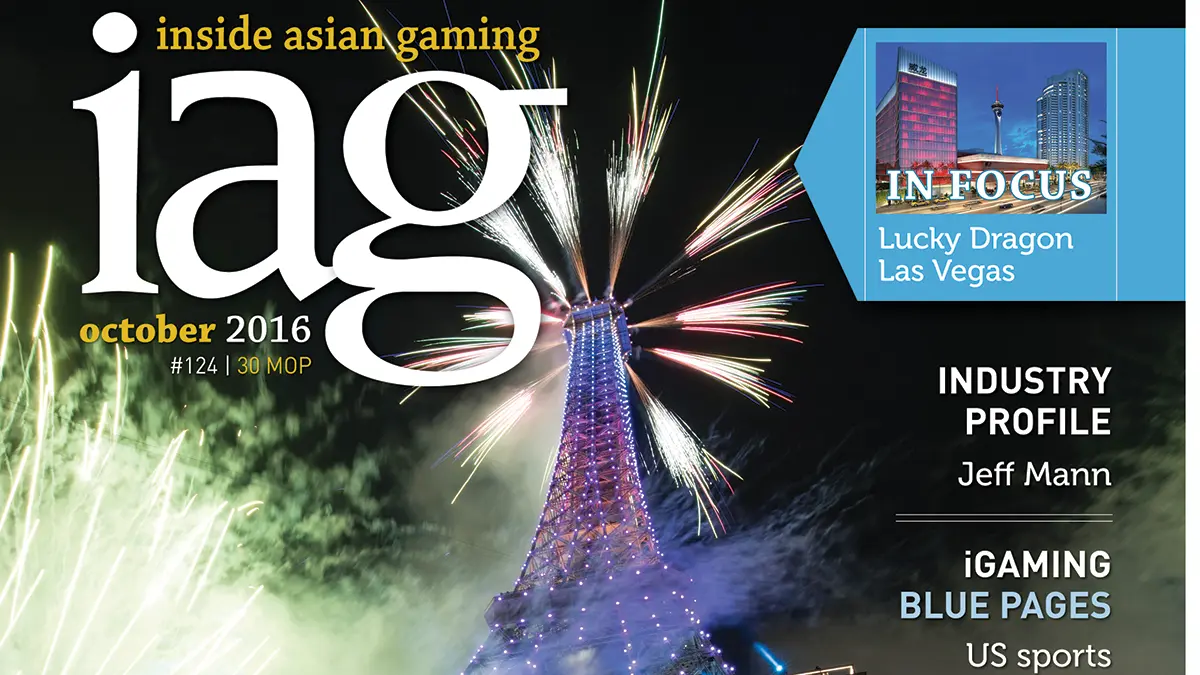

In this regular feature in IAG to celebrate 21 years covering the Asian gaming and leisure industry, we look back at our cover story from exactly 10 years ago, “French revelation,” to rediscover what was making the news in October 2016!
It is now 10 years since Sands China opened The Parisian Macao on the famed Cotai Strip.
 The company’s second themed Macau property after its next door neighbor, The Venetian Macao, Parisian brings the best of French grandeur to Asia’s gambling mecca, from its 30-meter tall Arc de Triomphe to the Palais Garnier-inspired hotel block façade, the Porte Cochere entryway reminiscent of railway station Gard du Nord and the Grand Palais and a main lobby rotunda boasting a replica of the Fontaine des Mers.
Not to forget, of course, the replica Eiffel Tower that stands tall along the Cotai Strip and remains a hugely popular attraction for Chinese tourists to this day. At exactly half the size of the Paris original, Macau’s version stands 162-meters or 28-storeys tall and boasts more than 2,800 metric tons (6.2 million pounds) of Shanghai-forged steel plus 6,600 LED bulbs, with observation decks on its 7th and 37th floors.
“Venetian and Parisian will be a dynamic force that will bring more people to Macau,” said Sands China’s founder, the late Sheldon Adelson, on 13 September 2016 – the property’s opening day. “On social media in China, people are most interested in Venetian; Parisian is now number two.”
 At a cost of US$2.9 billion, The Parisian Macao was launched as a predominantly mass market property, opening with 310 tables on its mass gaming floor versus around 100 serving premium customers. Less than half of those were junket.
Opening in the midst of President Xi Jinping’s anti-corruption campaign, which had put a dramatic end to Macau’s years-long era of explosive, VIP-led growth, this new mass and premium mass focus was already being viewed as the new norm.
Grant Govertsen, Union Gaming’s Head of Asia Equity Research, stated in 2016, “Simply put, we think Parisian is the right product targeting the right market segments at the right time. The property has generally exceeded our expectations and most importantly seems to hit the sweet spot of what a typical mainland mass market visitor generally responds well to: sense of grandeur, massive scale, European highlights.”
 Added Adelson, “We’ve always built for the mass. We didn’t start in the VIP market. The mass market will always be there.”
The opening of Parisian was also notable at the time for the 100 new gaming tables it was granted upon opening – with another 25 to be granted on 1 January 2017 and 25 more the following year – amid citywide uncertainty given the government’s table game cap, which limited the introduction of new tables to the city’s supply to an additional 3% each year.
With the government having stated its intention to diversify Macau’s economy away from its dependence on gaming, the promise was therefore that any allocation of new tables, particularly to newly opened IRs, would be determined by the ratio of non-gaming offerings above all else.
 In the end, The Parisian Macao’s 100 new tables on opening day – the other 310 were relocated from Sands’ other properties – was identical to that of Wynn Palace, which had opened less than a month earlier.
JP Morgan therefore suggested at the time that new table allocations “might be driven more by the timing of opening and the industry’s then-operating environment” rather than any other factors, a resolution that “reduced uncertainty” for the two other companies that were developing new Cotai properties at the time, MGM (MGM COTAI) and SJM (Grand Lisboa Palace).
The Parisian Macao was an early success, by 2019 generating revenue of US$1.65 billion and Adjusted EBITDA of US$544 million at a healthy 33% margin. This was less than half of The Venetian’s numbers but also off a considerably smaller footprint.
The going has been tougher more recently, with 2025 revenue coming in US$1.11 billion and Adjusted EBITDA at US$248 million. The property has been somewhat left behind by the group’s US$2 billion transformation of Sands Cotai Central into The Londoner Macao, while similar upgrade works are ongoing at The Venetian Macao. Management has hinted that Parisian will be next on the agenda.
What it continues to do, however, is contribute to Sands China’s expansive Cotai footprint, filling the final plot of land granted to the company along the Cotai Strip and adding 3,000 additional hotel rooms – since reduced to 2,541 as part of a suite conversion.
As Adelson said in 2016, “No one has believed more or invested more in Macau’s future as a leisure and business destination. We never wavered in our development plans, or our desire to serve as a model for the type of development which would help diversify Macau’s economy through the introduction and growth of important non-gaming attractions.”













