




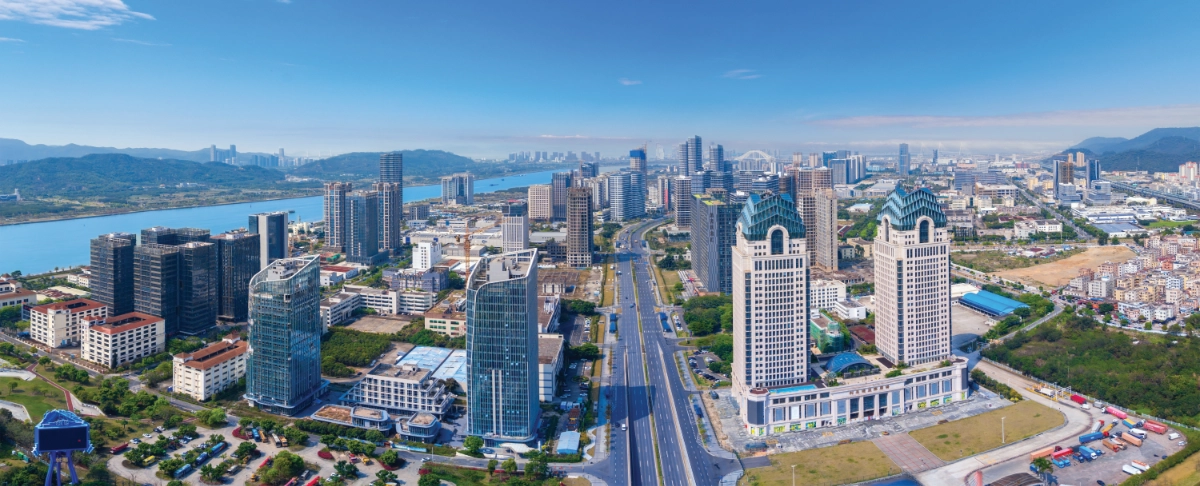

Macau has in recent years pushed forward the development of Hengqin. Separated from Macau only by a narrow stretch of water, this island once dubbed Macau’s “backyard” has evolved into a key platform for national policy delivery and for Macau to pursue appropriate economic diversification.
Some two decades ago, Hengqin was merely a remote outlying island under Zhuhai’s jurisdiction, with a permanent and registered population of roughly 7,000 and whose economy relied mainly on traditional fishing and farming. However, fueled by strong central government policy support, Hengqin has transformed into a city of high rise buildings. As of the first half of 2026, its permanent population stood at around 50,300 and its Gross Domestic Product (GDP) reached RMB 28.7 billion (US$4.26 billion), representing a 7.5 % year on year increase.
 Its development can broadly be split into two phases: Hengqin New Area, and the Guangdong Macau In Depth Cooperation Zone in Hengqin. The New Area era brought large scale development, turning rural farmland into a modern urban landscape yet also triggering real estate related turbulence. The Cooperation Zone phase marks the current era of diversified growth.
The large-scale development of Hengqin New Area
In 2009, the State Council adopted the Overall Development Plan for Hengqin, incorporating Hengqin Island into the Zhuhai Special Economic Zone. It was positioned as a demonstration zone for exploring new Guangdong Macau Hong Kong cooperation under “One Country, Two Systems” and as a pioneer zone for further reform, for opening up and for technological innovation. The State Infrastructure projects and the new campus of the University of Macau were successively launched, kicking off Hengqin’s large scale development. In 2014, Hengqin became one of the three zones of the China (Guangdong) Pilot Free Trade Zone, prioritizing Macau-related cooperation, tourism leisure and commercial services.
Macau developers across the water were bullish on Hengqin property. In 2012, Macau Legend’s affiliate Macau Legend Development Limited secured the first plot of land designated for Macau enterprises to build a large-scale commercial shopping complex, spanning roughly 30,000 square meters and featuring malls, retail outlets, dining facilities and cinemas. Legend Ponto Square opened in 2019 and quickly became a landmark hotspot. In recent years, however, Macau Legend has faced financial and operational headwinds; in 2025 it announced plans to sell the commercial square via public tender.
 Real estate frenzy
Hengqin’s large scale development coincided with a mainland property boom. Mainland and Hong Kong-Macau developers acquired land parcels and erected buildings, marketing projects heavily around “policy dividends.” Hengqin became a magnet for property investors.
Not all land parcels in Hengqin were zoned for residential use. Seeking profits, some developers re branded purely commercial office buildings as “commercial residential” properties for sale. After they were handed over, the new owners encountered numerous issues: no natural gas supply, inadequate catering infrastructure and title deed classifications inconsistent with actual usage. This spawned many consumer and civil disputes.
Subsequently, hit by the “three red lines” financing regulatory policy during the pandemic, some developers suffered broken capital chains. Multiple commercial office projects were left suspended or unfinished, further exacerbating building vacancy problems across the zone.
To resolve the oversupply of commercial real estate, the Guangdong Macao In Depth Cooperation Zone rolled out the “commercial to hotel conversion” policy in July 2024. The measure permits eligible idle commercial office buildings to be repurposed into hotels. In December 2024, SJM Holdings acquired selected office and retail units at Shun Tak Port Commercial Centre for RMB 546 million (US$81 million) and later expanded its acquisition with an additional outlay of around RMB 160 million (US$24 million). This demonstrates that capital is rebalancing asset portfolios through property function conversion.
 Guangdong Macau In Depth Cooperation Zone: a new era of co governance
In 2021, central authorities issued the Master Plan for the Construction of the Guangdong Macau In Depth Cooperation Zone in Hengqin, formally upgrading Hengqin to the Cooperation Zone status. No longer purely a Guangdong regional jurisdiction, it operates under the framework of “joint consultation, joint construction, joint management and shared benefits” for Guangdong and Macau. The Chief Executive of the Macao SAR Government and the Governor of Guangdong Province jointly chair its Management Committee. It implements the regulatory model of “first line liberalization, second line control”: the “first line” denotes the border between Hengqin Island and Macau SAR while the “second line” refers to the border between Hengqin Island and other Chinese customs territories.
The Cooperation Zone focuses on four key industries: R&D and high end manufacturing, traditional Chinese medicine, modern finance, and culture tourism. These align closely with Macau’s “1+4” strategy for appropriate economic diversification. Hengqin’s destiny is deeply intertwined with Macau; it is no longer merely a “backyard” but a core driver of future development. Sam Hou Fai, Chief Executive of the Macau SAR, has repeatedly emphasized that “Hengqin should be treated as Macau’s own affair.”
A suite of cross border policies for residents and enterprises has been rolled out to improve connectivity. From 1 January 2025, Cooperation Zone registered residents and residence permit holders can apply for multiple entry visas to Macau. Macau registered motor vehicles can obtain simplified cross-border access to Hengqin. For Macau entrepreneurs and enterprises setting up locally, rental subsidy schemes offer Macau-funded and major key project enterprises subsidies of up to RMB 80 per square meter per month to attract Macau capital investment and industrial agglomeration.

Future education – Driven New Town
Despite top tier policy backing and institutional frameworks, Hengqin still faces notable structural challenges, most acutely stock commercial real estate “low permanent resident numbers and weak capacity to attract people,” constraining its development.
Institutional disparities also create integration barriers. Though equipped with special cross-border management arrangements, Hengqin remains subject to mainland legal jurisdiction and the Renminbi monetary system. Fundamental divergences persist vis à vis Macau’s civil law judicial system and free foreign exchange regime. Complexities in cross- border capital transfers, alignment of commercial law rules and interoperable government services dampen long-term investment by Macau enterprise and Macau residents’ willingness to settle and work locally, forming hidden obstacles to deep integration.
To fundamentally address low population density, the education sector is tasked with drawing people and talent. The Cooperation Zone authorities are planning the Macau Hengqin International Education (University) Town, with total investment of roughly RMB 18 billion (US$2.67 billion), built in three phases from 2025 to 2030.
 In phase one, multiple Macau higher education institutions including the University of Macau, Macau Polytechnic University and Macau University of Tourism will move into the campus, projected to bring in more than 20,000 teachers and students. This will boost local population flows, stimulate consumption, research and development and industrial momentum, injecting lasting vitality into Macau Hengqin deep integration.
Twenty years on, Hengqin has transformed from a remote fishing village into the core zone for Guangdong Macau collaboration. Policy dividends and improved infrastructure have rapidly shaped its urban form and industrial framework. Nevertheless, practical hurdles remain: insufficient visitor resident inflows, high commercial building vacancy rates and imperfect alignment of institutional rules between the two sides.
As Macau Chief Executive Sam Hou Fai puts it, Hengqin affairs ought to be handled as Macau’s own. Hengqin is undoubtedly central to Macau’s future. Still, time will tell whether policy advantages can evolve into self sustaining industrial systems, breaking excessive reliance on policy stimuli.













