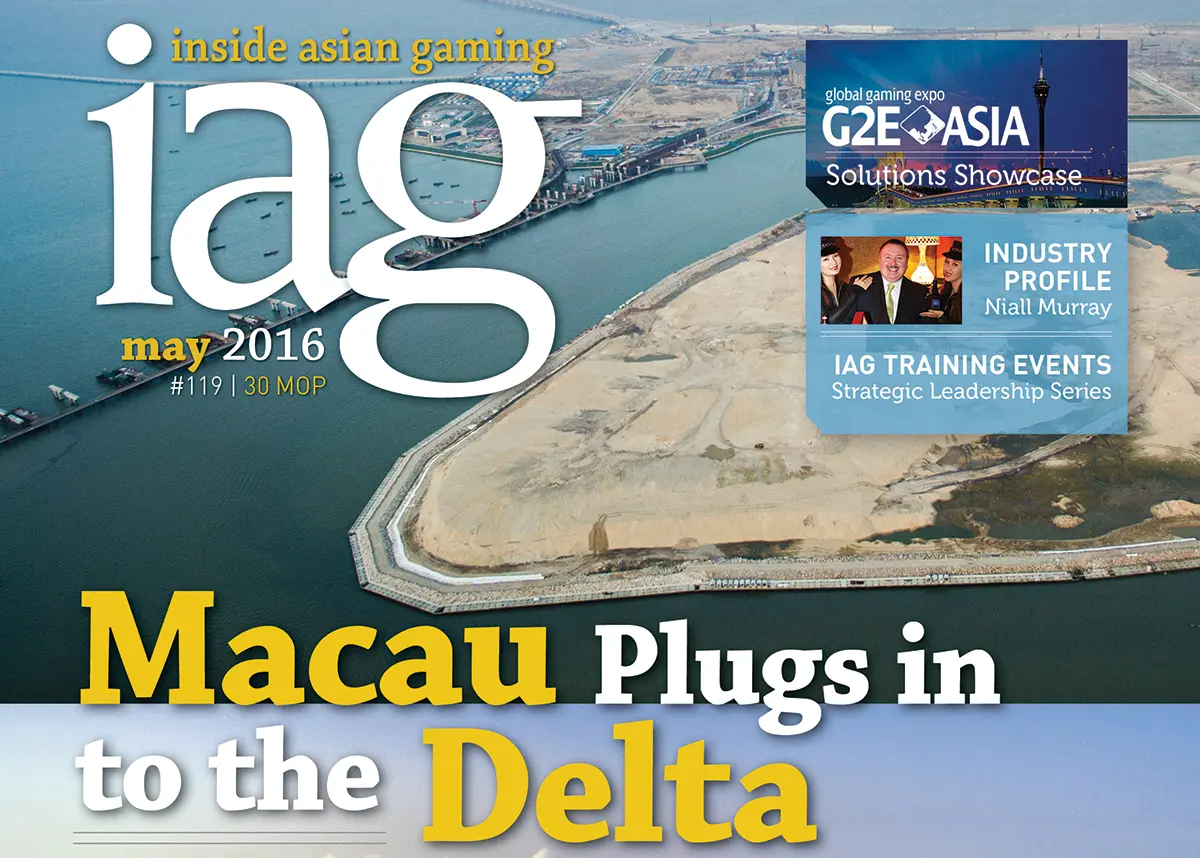

In this regular feature in IAG to celebrate 21 years covering the Asian gaming and leisure industry, we look back at our cover story from exactly 10 years ago, “Macau’s opportunity?”, to rediscover what was making the news in May 2016!
 In our May 2016 edition of Inside Asian Gaming, we took a deep dive look at the development of the US$15 billion mega-project that is the Hong Kong-Zhuhai-Macau Bridge (HZMB).
At that time, the HZMB was still almost two-and-a-half years way from opening and many questions still remained about the timing and cost, especially with multiple jurisdictions in charge of various elements of construction and each progressing at their own pace. But it was also a project of immense opportunity, connecting Hong Kong, Zhuhai and Macau in a manner that had never been realized before.
 As we wrote at the time, HMZB is part of a long-term vision of turning the Pearl River Delta into a “polycentric megacity region” – assuming the concept that development in a geographical area is more stable when it integrates several economic centers. That is, the fortunes of a region with only one big city will rise and fall with the cycle of that city whereas growth driven by different centers should be more sustained.
Although not the longest bridge in the world – that record goes to the Beijing to Shanghai high-speed railway’s Danyang- Kunshan Grand Bridge at 164.8 km long – or even the world’s longest sea bridge, it does contain the world’s longest immersed tube tunnel at 6.7 km. And, at around 55km in total length, the HZMB is still an epic triumph of human ingenuity.
Despite this, IAG posed the question in 2016 that the true power of the bridge would not necessarily be realized in its early years of operation, and for Macau perhaps not for some time beyond then.
 “You can’t be in a hurry if you want to lay a firm foundation,” Dr Joey Lao of the Macau Economic Association said when asked about the city’s ability to capitalize on the opportunity the bridge will offer. “The real benefits of the bridge will be reaped not in our generation but the next.”
Still, transportation times alone have been dramatically slashed since the bridge’s October 2018 opening, with the journey by truck between Hong Kong and Zhuhai falling from over four hours to around 40 minutes and travel between Macau and Hong Kong now under an hour. That’s slightly quicker than catching a ferry and perhaps a little easier too, although direct connectivity with Hong Kong International Airport may be the greatest benefit for those travelling to or from Macau.
As we wrote in 2016, “Today, air passengers flying into Hong Kong can take a ferry from the airport directly to Macau without passing Hong Kong’s border controls – but there are only five sailings each day. The new road link should dramatically increase the frequency of departures, by coach.
 “The big project could thus have a dramatic impact on Macau International Airport, which is small, offers a limited number of destinations and has been criticized as inefficient. Macau’s integrated casino resorts, for instance, may in future decide to fly in all of their Thai durian and Alaskan salmon via Chek Lap Kok’s highly efficient logistics terminal. And the number of air passengers passing through Macau airport could slump, as incoming gamblers opt instead to fly into its swankier counterpart.
“In short then, while HMZB will make little difference to tourist arrivals from Hong Kong or Southern China, it could greatly improve access to Macau from further afield.”
Given the Macau government’s recent push to boost international visitation to Macau, the increased connectivity the HZMB provides may well make the city’s own US$250 million investment into the project money well spent.