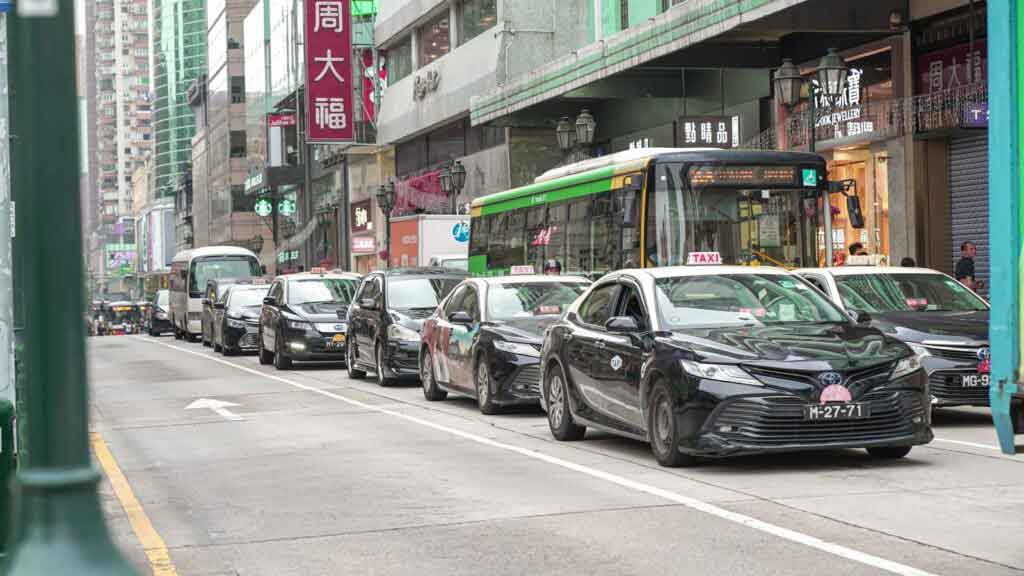

With Uber announcing its return to Macau, discussions about “ride-hailing taxis” have resurfaced. In fact, at least two companies in Macau are already providing services that allow passengers to book taxis via mobile apps, websites or online platforms. However, since Macau has not yet established a legal framework specifically for “ride-hailing taxis”, public attention remains focused on issues such as platform pricing, operating models and legality.
Uber recently announced that it would return to Macau in the form of “Uber Taxi” and has launched services connecting Hong Kong and Macau. Meanwhile, as early as mid-last year, Amap – a mainland Chinese digital map content provider – entered the Macau market and partnered with local mobile payment platform MPay to introduce an online taxi-booking service.
Yet, to date, Macau still has no dedicated legislation regulating what people commonly call “ride-hailing taxis” – booking legally compliant taxis through an online platform. As a jurisdiction grounded in a codified legal system, a key question is whether the operation of such platforms in the absence of clear regulations, violate existing laws.
Does “no extra charge” mean no illegality?
The current legal regime for passenger transport in light rental vehicles sets out clear rules on how taxi fares must be charged: taxi drivers must calculate fares using an in-vehicle taximeter and they must not overcharge – violations may be found even where the amount involved is minor.
In other words, taxi fares may only be calculated based on the taximeter. Even if a passenger books a ride through an online platform, the driver may only collect payment according to the taximeter. Platform companies likewise may not add charges or take a commission on top of the metered fare.
“Platforms cannot charge fees out of the fare at this stage, because the law provides that taxi fares are calculated by the taximeter,” said Raymond Leng Sai Vai, Chairman of the Macau Motor Vehicle Commercial and Industrial Association (Associação dos Comerciantes e Operários de Automóveis de Macau).
“At present, ride-hailing taxi services still rely on the taximeter for fare collection and the platform cannot collect fees from it.”
This suggests that platforms offering ride-hailing taxi services at this stage are likely operating by providing the service for free. However, Leng added that “even if platforms cannot charge for the time being, they can take this opportunity to capture the market and aim for a larger market share once the law takes effect.”
Uber’s return illustrates this strategy, as it immediately introduced subsidies to attract drivers to register. Drivers who complete their first trip between now and 28 February 2026 will receive a MOP$500 bonus and if they complete an additional 60 trips within 14 days from the date of their first trip they can receive an extra MOP$1,500 incentive.
The government response
After Uber’s announcement, the Transport Bureau and the Public Security Police Force issued a joint press release stating that taxi operations must comply with the legal regime for passenger transport in light rental vehicles. This includes requirements that only taxis holding valid licenses may operate and that they must be driven by persons holding a valid taxi driver permit.
The two authorities also reminded the industry that if taxi practitioners fail to charge according to statutory fare rules or accept an order and then fail to show up, they may breach provisions related to overcharging or refusal of service, and the authorities will handle such cases in accordance with the law.
In addition, the government stated that it is actively making amendments to regulate ride-hailing taxi service platforms, with plans to introduce more standardized management to better safeguard the rights and interests of passengers and drivers.
Are ride-hailing taxis inevitable?
In recent years, the Macao SAR Government has shown noticeably greater attention to the “ride-hailing taxi” issue – likely in response to ongoing concerns over the supply and quality of Macau’s existing taxi services. Macau’s Chief Executive Sam Hou Fai has mentioned “ride-hailing taxis” multiple times in public addresses. Meanwhile, the Secretary for Transport and Public Works, Tam Vai Man, said at the Legislative Assembly in January that the government is actively advancing research on introducing ride-hailing taxi services and a regulatory platform. The plan is to implement ride-hailing taxis first and then, depending on the results, consider promoting private ride-hailing cars.
Leng also said the government has consulted the industry on “ride-hailing taxis”. Early discussions suggest that platform commissions may be capped at no more than 30% of the fare, and that two to three platform operators may be introduced in the future. He emphasized, however, that these points have not been finalized and remain preliminary.
Overall, judging from the government’s stance and public reaction, “ride-hailing taxis” appear to be an emerging trend. Moreover, Macau is expected to add 800 taxis in the future in the hope of easing travel inconvenience for residents and tourists.