


Regional expertise, worldwide
  • Subscribe
  • Magazines
  • About
  • Contact
  • Advertise
Friday 13 November 2026
  • zh-hant 中文
  • ja 日本語
  • en English
IAG
Advertisement
  • Newsfeed
  • Mag Articles
  • Video
  • Opinion
  • Tags
  • Regional
    • Africa
    • Australia
    • Cambodia
    • China
    • CNMI
    • Europe
    • Hong Kong
    • India
    • Japan
    • Laos
    • Latin America
    • Malaysia
    • Macau
    • Nepal
    • New Zealand
    • North America
    • North Korea
    • Philippines
    • Russia
    • Singapore
    • South Korea
    • Sri Lanka
    • Thailand
    • Vietnam
  • Events
  • Contributors
  • SUBSCRIBE FREE
No Result
View All Result
IAG
No Result
View All Result

Macau Policy Watch

Newsdesk by Newsdesk
Mon 8 Feb 2010 at 16:00
7
SHARES
167
VIEWS
Print Friendly, PDF & Email

Implication 1: Property prices affect VIP growth

The underlying motivation behind the recent monetary tightening announcements are to cool down property prices in China, which rose significantly (26%) over the last 18 months. Hence, the question in the minds of investors should also be that even if monetary policy is not tightened any further, will the PRC government’s desire to cool property prices have any implication for Macau’s property market?

Our analysis indicates that there is reason to be cautious on Macau’s VIP revenues (rather than mass-market revenues) given cooling property prices.

The chart below shows the relationship between property prices and Macau’s VIP gaming market, extending back to 2003, and illustrates that VIP gaming revenues in Macau are affected by property prices with a three-month delay. We can see that happening during several points in time, the latest being 2008/09. However, while the China-wide property price decline may not look as significant in 2008/09, the decline for Guangzhou and Shenzhen was more significant, with prices falling 15–35%.
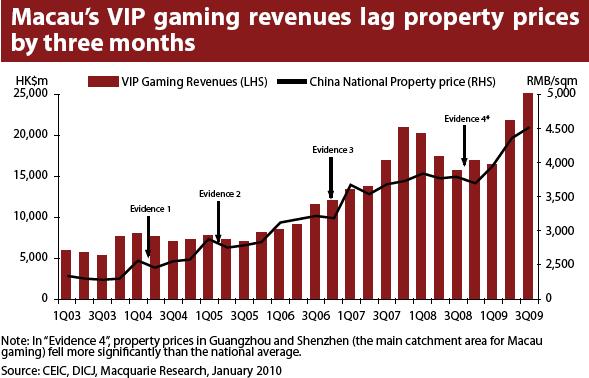
Intuitively and based on our discussions with industry sources and junket operators, we think there will be an impact on Macau’s gaming market from cooling/declining property prices.

This makes sense, mainly because cooling property prices in a high inflationary environment (what China is currently facing) should make consumers feel as though they have less spending power and hence should pull back on discretionary spending (such as gambling).

Falling property prices have a negative multiplier effect on junkets

There is an even bigger reason why property prices have an impact on the VIP segment specifically. We understand property in China is one of the main sources of collateral that junket operators use against credit provided to VIP players. Hence, if property prices start to fall, junkets would be more cautious about the level of credit extended to VIP players. The inability to turn over the asset and turn the credit into cash (as property transaction volumes also decline) means the extent to which junkets can multiply their credit (or the multiplier effect) also declines. Hence, this would affect the level of VIP turnover in the market.

Mass market proves to be more resilient and less affected

Interestingly, our analysis also indicates that Macau’s massmarket revenues are not as sensitive to property prices in China. This is shown in the following chart, which illustrates that even at points in time when property prices have fallen, Macau’s mass-market gaming revenues generally bucked the trend and continued to grow. The 2008/09 period was an exception, although this was seen only in one quarter (which coincided with visa restrictions), following which, it grew rapidly.

We believe that the mass-market resilience is driven by two factors:

  • The mass market relies less on credit and more on the savings/ earning power of consumers in China. Hence, money supply has less of a direct impact on gambling habits.
  • Macau has not significantly penetrated the mass-market customer base in China. Hence, although some people may choose not to frequent casinos as economic circumstances change, they are replaced by others who have not been to Macau and want to visit there.

Dynamics for mass market remain positive

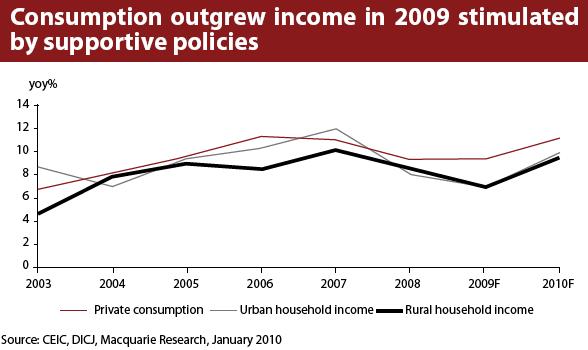
The analysis conducted by our retail analyst, Jessie Qian, and China economist, Paul Cavey, supports our view that although monetary tightening may affect the VIP credit environment, the mass market should remain strong as long as consumer confidence and earning power remains strong.

As shown in the chart below, while the reduction in workers incomes has been well publicised, private consumption has still grown quite strongly, supported by government stimulus measures.

RelatedPosts

MGM officially launches “Oktoberfest Macau at MGM 2026″

MGM officially launches “Oktoberfest Macau at MGM 2026″

Wed 28 Oct 2026 at 18:17
10 Years Ago – French revelation

Sands China to raise US$1 billion through new senior notes offering

Wed 28 Oct 2026 at 07:19
Macau GGR down 1.2% year-on-year to MOP$18.1 billion in September

CreditSights: Still too early to deem Macau gaming softness as structural

Tue 27 Oct 2026 at 15:56
Gaming credit law changes to reflect measures banning junkets from accepting player deposits

Sands China proposes new notes issue to refinance US$700 million debt

Tue 27 Oct 2026 at 07:53
Load More
Page 2 of 6
Prev123...6Next
Tags: MacauPolicy
Share3Share
Newsdesk

Newsdesk

The IAG Newsdesk team comprises some of the most experienced journalists in the Asian gaming industry. Offering a broad range of expertise, their decades of combined know-how spans multiple countries across a variety of topics.

Current Issue

Editorial – Unraveling the gambling prohibition paradox

Editorial – Unraveling the gambling prohibition paradox

by Ben Blaschke
Wed 30 Sep 2026 at 19:32

I can’t help but notice the sudden and rapid emergence of the term “channelization” across the Asia-Pacific regulatory gaming space...

Reality check – Osaka looms over Korea’s casino boom

Reality check – Osaka looms over Korea’s casino boom

by Ben Blaschke
Wed 30 Sep 2026 at 19:10

Korea’s foreigner-only casinos are setting record revenue numbers, but they are also acutely aware of dark clouds on the horizon...

IAG EXPO 2026 – Elevating the Discussion

IAG EXPO 2026 – Elevating the Discussion

by Ben Blaschke
Wed 30 Sep 2026 at 18:41

The 2026 IAG EXPO was a week of celebration and intense discussion, with the common theme being that this is...

Loyalty in Numbers

Loyalty in Numbers

by Kelsey Wilhelm
Wed 30 Sep 2026 at 18:08

AI is reshaping how integrated resorts can identify and benefit not only premium customers but also grind mass, breaking the...

Hoiana banner
Aristocrat banner
GLI
Nustar
Solaire
Hann
NWR


IAG

© 2005-2026
Inside Asian Gaming.
All rights reserved.

  • SUBSCRIBE FREE
  • NEWSFEED
  • MAG ARTICLES
  • VIDEO
  • OPINION
  • TAGS
  • REGIONAL
  • EVENTS
  • CONSULTING
  • CONTRIBUTORS
  • MAGAZINES
  • ABOUT
  • CONTACT
  • ADVERTISE

Welcome Back!

Login to your account below

Forgotten Password?

Retrieve your password

Please enter your username or email address to reset your password.

Log In

Add New Playlist

No Result
View All Result
  • Subscribe
  • Newsfeed
  • Mag Articles
  • Video
  • Opinion
  • Tags
  • Regional
  • Events
  • Contributors
  • Magazines
  • Advertise
  • Contact
  • About

© 2005-2026
Inside Asian Gaming.
All rights reserved.

  • English